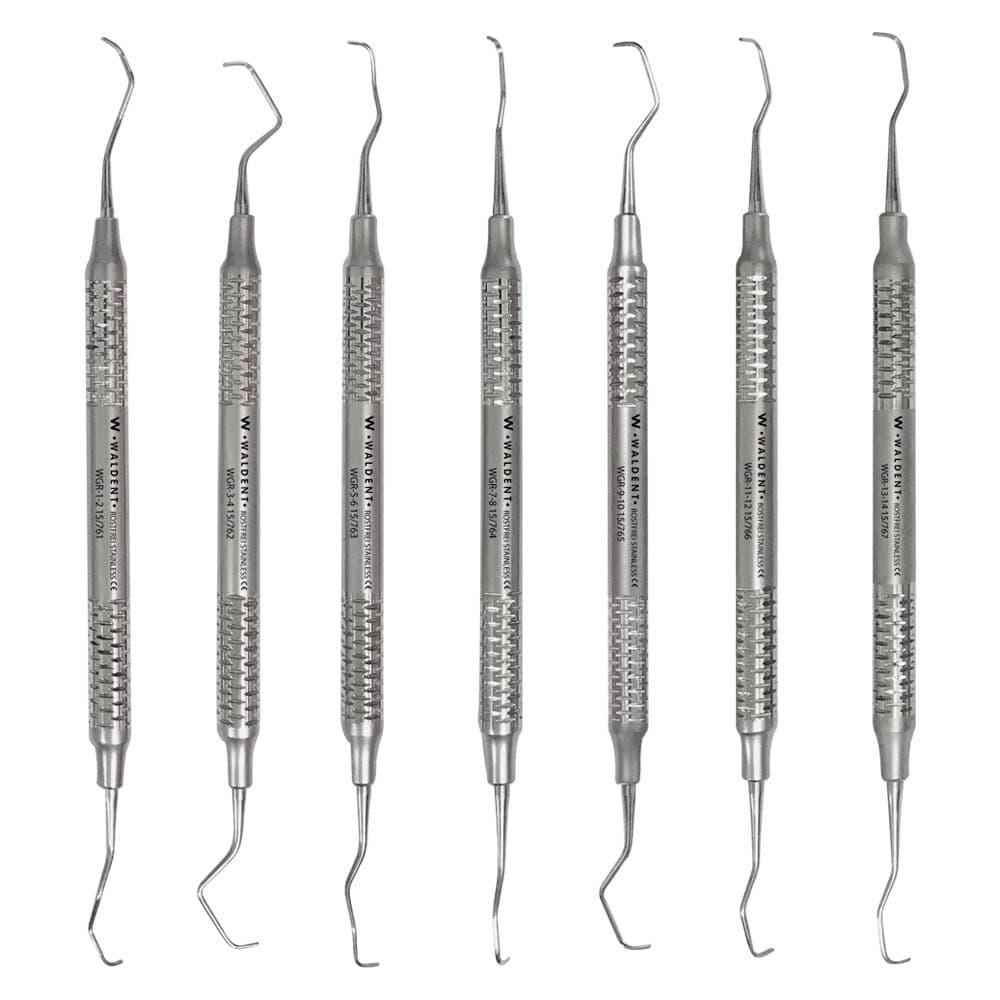
The Waldent Gracey Curettes Set of 7 gives you everything you need for subgingival scaling and root planing in periodontal work. Each instrument in the curette set is area-specific, meaning each one handles a particular tooth surface or region. This design cuts down on unnecessary trauma to surrounding tissues while you work in periodontal pockets.
Waldent manufactures these instruments from Rostfrei stainless steel, which is a German-grade material known for holding its shape and resisting breakage. The steel is corrosion-resistant, which matters since these instruments go through high-pressure autoclave sterilization repeatedly. The company uses skilled workers and modern machinery to control quality at every stage of production.
What makes the set different from universal curettes is the 70-degree offset blade. This creates a single cutting edge, the lower edge, that's already positioned for the correct angle. You don't have to figure out the blade angle yourself. The area-specific design means each curette in the set targets specific tooth surfaces. The dental gracey curettes offer advantages over general-purpose instruments because of this targeted approach to different areas of the mouth. You get the Gracey 1/2 and 3/4 for anterior teeth, the 5/6 for anteriors and premolars, the 7/8 for buccal and lingual surfaces, the 9/10 for posterior molars, and the 11/12 and 13/14 for mesial and distal surfaces, respectively.
The instruments come with long shanks where needed for access, shorter shanks where the tooth is easier to reach, and contra-angles that match the anatomy of different areas. This thoughtful design means less strain on your hand and wrist during extended clinical sessions. The dental gracey curettes are built to last. With proper care and sterilization, they maintain their edge and structural integrity through years of use.
Product Uses
- Scaling and root planing on subgingival tooth surfaces during periodontal therapy.
- Getting to and treating periodontal pockets with as little damage to the tissue as possible
- Cleaning out calculus and deposits on the roots of teeth in all parts of the mouth
- Precise interproximal scaling and root planing on eeth and premolars
- Taking care of the buccal and lingual surfaces of premolars and molars
- Getting to the mesial and distal root surfaces of the back teeth
- Using area-specific tools on patients with deep pockets
- Performing efficient and targeted periodontal maintenance sessions
- Managing moderate to severe periodontal disease in clinical settings
- Helping general dentists with periodontal therapy
- Making it easier to undertake subgingival debridement in speciality periodontal settings
- Training students and residents on proper gracey curette technique
How to Use
Step 1: Prepare the instruments
Take the curettes out of their package and inspect each one. Look for any damage, corrosion, or dull areas on the cutting edge. If any instrument looks compromised, don't use it. Place the curettes in your sterilization tray or cassette. If they're used instruments, clean them first with an appropriate cleaning solution to remove biofilm and deposits. Rinse thoroughly with water.
Step 2: Sterilize properly
Place the instruments in your high pressure autoclave following standard sterilization protocols. Most dental instruments are sterilized at 121 degrees Celsius for 15 to 20 minutes at 15 to 17 PSI. These curettes items handle standard autoclave procedures without issue. Allow them to cool completely before removing from the autoclave.
Step 3: Select the right curette
For anterior work, grab the Gracey 1/2 or 3/4. The 1/2 has a particularly long shank that helps you reach lower anteriors when the patient is reclined. The 3/4 works similarly but with slightly different angulation. For interproximal work on anteriors and premolars, use the Gracey 5/6. When you're working on buccal and lingual surfaces of premolars and molars, the Gracey 7/8 is your go-to. It's one of the most versatile instruments in the set.
Step 4: Establish the correct position
Hold the curette so the lower cutting edge contacts the tooth. The terminal shank should run parallel to the tooth surface you're treating. This is the correct adaptation. If the shank isn't parallel, you won't get good contact, and the instrument won't work as designed.
Step 5: Apply proper pressure and technique
Apply lateral pressure against the tooth or root surface. Pull upward while maintaining that parallel shank position. The blade does the work; you don't need heavy pressure. Use controlled, deliberate strokes. The dental gracey curettes are designed to work efficiently once you've positioned them correctly.
Step 6: Access different areas
For posterior teeth buccal and lingual surfaces, especially around the bifurcation where access is tight, the Gracey 9/10 shines when using a horizontal technique. Its wide contra-angle and nearly inline toe position make it suited for the least accessible root surfaces. For mesial surfaces of posterior teeth, use the Gracey 11/12. For distal surfaces, switch to the 13/14. These two act as a pair and feature notably long tips, permitting access to the posterior teeth while keeping your hand comfortably out of the patient's mouth.
Step 7: Work systematically
Use the instruments in the set to completely scale all tooth surfaces. Starting with anteriors and moving to posteriors keeps you organized and ensures you don't miss any areas. Change instruments as you move from one region to the next.
Step 8: Clean after use
After clinical use, place the instruments back in the sterilization cassette immediately. Rinse off any visible debris. Clean them with an instrument cleaner or an enzymatic solution. Rinse well and allow to air dry before sterilization.
Product Features
- Design for specific areas that target different tooth surfaces and areas
- A 70-degree offset blade makes a single lower cutting edge
- Rostfrei stainless steel makes it strong and long-lasting
- An alloy that doesn't rust can handle being sterilized over and over again
- Long shanks on front instruments for comfort and easy access for patients
- Shorter shanks on tools that are used in the back of the mouth, where teeth are easier to reach
- Contra-angles that fit the shape of teeth in different places
- A smooth, bladed toe design prevents tissue gouging and minimizes trauma
- Gracey 7/8 features a hooked toe standing off-line to comfortably counter any tendency to twist during insertion
- A comprehensive seven-piece set providing complete coverage for all tooth surfaces
- Instruments stay sharp even after a lot of use.
- Ergonomic handles designed to reduce hand fatigue during extended clinical procedures
- Works with high-pressure autoclave sterilization
- Fully reusable instruments that reduce clinical waste and provide excellent long-term cost efficiency
- Minimal damage to the periodontal tissues around it
- A design that has been employed in practices around the world for decades
Technical Specification
| Specification | Details |
| Product Name | Waldent Gracey Curettes Set of 7 |
| Included Instruments | Gracey 1/2, 3/4, 5/6, 7/8, 9/10, 11/12, 13/14 |
| Material | Rostfrei Stainless Steel |
| Blade Offset | 70 degrees from the shank |
| Cutting Edges | Single lower cutting edge per instrument |
| Design Type | Area-specific curettes |
| Anterior Instruments | Gracey 1/2, 3/4 with long shanks |
| Anterior Premolar Instrument | Gracey 5/6 for interproximal use |
| Posterior Buccal/Lingual | Gracey 7/8 with medium contra-angle |
| Posterior Buccal/Lingual Molars | Gracey 9/10 with wide contra-angle |
| Posterior Mesial Surfaces | Gracey 11/12 with small contra-angle |
| Posterior Distal Surfaces | Gracey 13/14 with exaggerated curl |
| Corrosion Resistance | Yes, suitable for repeated sterilization |
| Autoclave Compatible | Yes, standard dental sterilization |
| Reusable | Yes, with proper cleaning and sterilization |
| Handle Type | Non-slip ergonomic design |
| Intended Users | Dentists and dental hygienists |
Handling Tips
- Store the instruments in a dry environment after sterilization. Don't leave them sitting in wet conditions, or they can develop water spots. Keep them away from harsh chemicals when not in use.
- Handle them carefully to avoid dropping on hard surfaces. Even though they're sturdy, impact damage can dull the blade or crack the instrument. Use instrument trays or cases to protect them during storage and transport.
- Clean the instruments immediately after use. Dried biofilm becomes harder to remove and can damage the cutting edge if you try to scrub it off aggressively. An enzymatic cleaner works better than abrasive methods.
- Don't soak the instruments in salt water or aggressive solutions for extended periods. The stainless steel is corrosion-resistant, but prolonged exposure to harsh chemicals isn't necessary.
- Inspect the cutting edges regularly. If an instrument starts to dull, have it professionally sharpened. A dull curette requires more pressure and can cause tissue trauma.
- When sterilizing, follow your autoclave manufacturer's recommendations. Make sure the instruments are completely dry before autoclaving to prevent water spots and corrosion.
- Don't mix these instruments with other metal instruments during sterilization if possible. Different metal types can react with each other under heat.
Product Packaging
The Waldent Gracey Curettes Set of 7 arrives as follows:
- 1 Gracey Curette 1/2 for anterior
- 1 Gracey Curette 3/4 for anterior
- 1 Gracey Curette 5/6 for anterior and premolar teeth
- 1 Gracey Curette 7/8 for buccal and lingual surfaces
- 1 Gracey Curette 9/10 for posterior buccal and lingual
- 1 Gracey Curette 11/12 for posterior mesial surfaces
- 1 Gracey Curette 13/14 for posterior distal surfaces
- Product documentation and care instructions
Medical Disclaimer
These instruments are intended for professional dental use only. Only trained and qualified dental professionals should use this gracey curettes set. Proper handling, correct instrumentation technique, appropriate sterilization, and standard infection control measures must be followed at all times.
The manufacturer and supplier assume no responsibility for misuse, improper handling, incorrect technique, or use outside the intended clinical application. Users must be trained in periodontal instrumentation before using these instruments. Improper technique can cause tissue trauma or ineffective treatment.
Warranty and Support
The curette set comes with a manufacturer's warranty covering defects in material and workmanship. Contact the supplier with any warranty questions or if you receive a damaged instrument. Most suppliers offer straightforward replacement of defective items.
If an instrument breaks during normal use, contact your supplier. Document the issue and when it occurred. The supplier will determine coverage based on the circumstances.
Proper care and maintenance extend instrument life significantly. Following sterilization and cleaning guidelines helps avoid premature wear.
Certifications
The Waldent Gracey Set of 7 has passed all of the standard safety and quality tests for dental tools. These instruments meet all regulatory standards and compliance requirements for professional dental equipment.
FAQ
Q. What exactly are Gracey curettes used for?
A. They're used for scaling and root planing on subgingival tooth surfaces. Each instrument targets specific areas of the mouth, making them more efficient than universal curettes for detailed periodontal work.
Q. How are the gracey curettes different from universal curettes?
A. The key difference is the 70-degree blade offset and area-specific design. Each curette is already angled correctly for its intended tooth surface. Universal curettes require you to establish the correct angle yourself, which takes more skill and time.
Q. Which Gracey curettes in this set are used for gracey curette for anterior teeth?
A. The Gracey 1/2 and 3/4 are specifically designed for anterior teeth. The 1/2 has a longer shank, making it exceptionally useful for reaching lower anteriors when the patient is in a supine position.
Q. Who should use this set?
A. Dentists and dental hygienists, trained in periodontal instrumentation. These aren't for untrained personnel.
Q. Are these instruments reusable?
A. Yes. With proper cleaning and sterilization, they last for years. The Rostfrei stainless steel resists corrosion and maintains its integrity through repeated use.
Q. Can they go in a high-pressure autoclave?
A. Yes, absolutely. Standard dental autoclave procedures work fine. They handle 121 degrees Celsius for 15 to 20 minutes without any issues.
Q. Will the cutting edges stay sharp?
A. They maintain sharpness well through normal use. If they do dull, professional sharpening restores them. Don't use abrasive materials to clean them, as that can damage the edges.
Q. How do I know which curettes to use on which teeth?
A. Each instrument number corresponds to its intended area. The 1/2 and 3/4 go on anteriors, 5/6 on anteriors and premolars, 7/8 on posterior buccal and lingual, 9/10 on posterior molars, 11/12 on mesial surfaces, and 13/14 on distal surfaces.
Q. What if an instrument gets damaged?
A. Don't use it. Contact the supplier about replacement options. Using a damaged instrument can cause injury or poor clinical results.
Q. Is special storage required?
A. Just keep them in a clean, dry place. A sterilization cassette or instrument tray works well. Don't leave them wet or exposed to harsh chemicals.
Conclusion
The Waldent Gracey Curettes Set of 7 has the perfect tool for each part of the mouth that needs periodontal care. These tools are easy to use and work well since they are made for specific areas, are made of high-quality Rostfrei stainless steel, and have shank lengths that are well thought out. This curette set can handle both anterior and deep posterior pockets with little damage to the surrounding tissue. This kit is a good investment for any dental office that does a lot of periodontal work because it will pay for itself over the years of consistent clinical use.