Global Medical Equipment Exporter · UK · EU · Africa · GCC
Global Medical Equipment Exporter · UK · EU · Africa · GCC

1 / 3
CE Marked
ISO 13485
Questions about this product?
— our team will reach out.
Therapy Equipments · Ultrasonic Therapy
Super Pro 1 & 3 MHz Ultrasonic Therapy Machine
$161
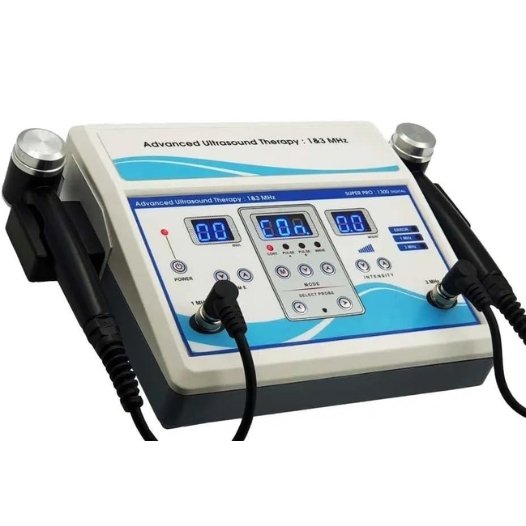
Dual-frequency 1 MHz and 3 MHz probes: two independent treatment heads allow deep tissue penetration with the 1 MHz probe and superficial tissue treatment with the 3 MHz probe, selectable via the probe selector button.:::
Four output modes: continuous, pulse A, pulse B, and wave modes provide a full range of ultrasonic output waveforms for acute, sub-acute, and chronic conditions.:::
Digital intensity display in W/cm²: three digital displays show timer (minutes), mode, and output intensity in watts per square centimetre for precise, reproducible treatment delivery.:::
Error and probe status indicators: dedicated LED indicators for error, 1 MHz, and 3 MHz probe contact confirm correct operation and alert the clinician to poor coupling or disconnected probes.:::
Top Highlights
- Model
- Super Pro 1300 Digital
- Frequencies
- 1 MHz (deep tissue) and 3 MHz (superficial tissue)
- Output modes
- Continuous, Pulse A, Pulse B, Wave
- Intensity display
- Digital, in W/cm²
- Timer
- Digital timer display (minutes)
- Probe selector
- Switchable between 1 MHz and 3 MHz probes
- Status indicators
- Error, 1 MHz, and 3 MHz LED indicators
- Certifications
- ISO 13485 & CE marked, documentation available
Guaranteed Safe And Secure Checkout








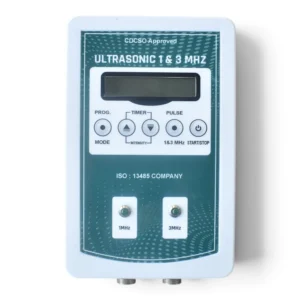
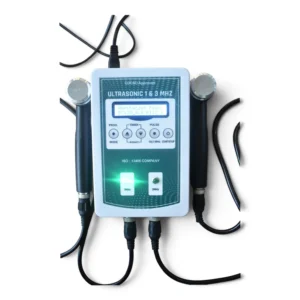
The Super Pro 1300 Digital is a dual-frequency ultrasonic therapy machine equipped with both a 1 MHz and a 3 MHz treatment probe. The two frequencies address different tissue depths: the 1 MHz probe penetrates deeper to treat muscles, tendons, and joints, while the 3 MHz probe is optimised for superficial soft tissue conditions. Both probes connect to the same digital control unit and are selected via the probe selector on the front panel. Four output modes including continuous, pulse A, pulse B, and wave enable clinicians to tailor the ultrasonic waveform to the stage and nature of the condition being treated. Three digital displays show timer, mode, and output intensity in W/cm² simultaneously, supporting accurate and reproducible protocol delivery across all sessions.
1 + 3 MHz
Dual probe frequencies
4 modes
Cont, Pulse A, Pulse B, Wave
3 displays
Timer, mode, and W/cm²
Digital
Super Pro 1300 Digital
Key features
1
Dual 1 MHz and 3 MHz probes
Two independent treatment heads cover the full range of tissue depths. The 1 MHz probe is suited to deep muscle and joint treatment; the 3 MHz probe addresses superficial soft tissue conditions.
2
Four selectable output modes
Continuous mode delivers uninterrupted ultrasound output. Pulse A and Pulse B modes deliver pulsed waveforms at different duty cycles. Wave mode provides a modulated output, each suited to different stages of tissue healing.
3
Digital intensity display (W/cm²)
Output intensity is shown in real time on a digital display calibrated in watts per square centimetre, enabling clinicians to set and verify the prescribed therapeutic dose accurately.
4
Digital timer display
A dedicated digital timer in minutes allows precise session duration to be set and monitored, supporting consistent and reproducible treatment protocols.
5
Probe selector button
A single probe selector button on the front panel switches the active output between the 1 MHz and 3 MHz probes without reconnecting cables, enabling efficient clinical use.
6
Error and probe status LEDs
Dedicated LED indicators for error, 1 MHz probe contact, and 3 MHz probe contact confirm correct coupling during treatment and alert the clinician to probe lift-off or connection issues.
7
Intensity gradient display
A bar-graph style intensity indicator on the panel provides a quick visual reference of the current output level alongside the precise digital W/cm² readout.
8
Compact desktop design
The unit's compact form factor and integrated cable management make it suitable for physiotherapy treatment rooms, rehabilitation clinics, and multi-bay therapy departments.
| Model | Super Pro 1300 Digital |
| Device type | Dual-frequency ultrasonic therapy unit |
| Frequencies | 1 MHz and 3 MHz (selectable via probe selector) |
| Output modes | Continuous, Pulse A, Pulse B, Wave |
| Intensity range | Adjustable; displayed digitally in W/cm² |
| Displays | Three digital displays: timer (min), mode, and intensity (W/cm²) |
| Status indicators | LED indicators for Error, 1 MHz probe contact, 3 MHz probe contact |
| Probe selector | Front-panel button to switch between 1 MHz and 3 MHz probes |
| Timer | Digital programmable timer (minutes) |
| Power supply | Mains AC, 110V / 220V, 50/60 Hz |
| Enclosure | Compact desktop unit with front control panel |
| Intended environment | Professional physiotherapy and rehabilitation clinical settings |
| Control | Function |
|---|---|
| Power button | Switches the unit on or off |
| Timer display (min) | Digital display showing the set and elapsed treatment session duration in minutes |
| Time up / down buttons | Increment or decrement the session timer value |
| Mode display | Central digital display showing the currently selected output mode (CONT, PULSE A, PULSE B, WAVE) |
| Mode selector buttons (CONT / PULSE A / PULSE B / WAVE) | Select the ultrasonic output waveform mode for the treatment session |
| Select Probe button | Switches the active output between the 1 MHz and 3 MHz probes without disconnecting cables |
| Intensity display (W/cm²) | Digital display showing the current output intensity in watts per square centimetre |
| Intensity up / down buttons | Adjust the output intensity level up or down to the prescribed therapeutic value |
| Intensity bar graph | Visual indicator showing relative intensity level alongside the precise digital readout |
| ERROR LED indicator | Illuminates to alert the clinician to a fault condition, probe disconnection, or insufficient coupling |
| 1 MHz LED indicator | Confirms active contact and output via the 1 MHz probe during treatment |
| 3 MHz LED indicator | Confirms active contact and output via the 3 MHz probe during treatment |
| 1 MHz probe socket | Connection point for the 1 MHz treatment head cable |
| 3 MHz probe socket | Connection point for the 3 MHz treatment head cable |
| Condition / Area | Application / Protocol |
|---|---|
| Musculoskeletal pain | 1 MHz for deep muscle and joint pain; 3 MHz for superficial soft tissue; continuous or pulsed mode as clinically indicated |
| Soft tissue injuries | Pulsed mode (Pulse A or B) for acute and sub-acute ligament, tendon, and muscle injuries to reduce thermal effect |
| Tendinopathy and tendinitis | 1 MHz for deep tendons (Achilles, rotator cuff); 3 MHz for superficial tendons; pulsed mode in acute phase, continuous in chronic phase |
| Scar tissue management | 3 MHz probe with continuous mode for superficial scar tissue softening and remodelling |
| Shoulder conditions | 1 MHz probe for periarticular and capsular conditions; pulsed mode in acute presentations |
| Knee and hip pathology | 1 MHz probe for joint capsule, ligament, and periarticular soft tissue conditions |
| Plantar fasciitis | 1 MHz probe applied to the plantar fascia insertion; pulsed mode for acute pain, continuous for chronic stiffness |
| Sports injury rehabilitation | Frequency and mode selection guided by tissue depth and healing stage under physiotherapist supervision |
The Super Pro 1 & 3 MHz Ultrasonic Therapy Machine is ISO 13485 & CE marked, confirming compliance with applicable European medical device directives for safety and electromagnetic compatibility. ISO & CE documentation is available on request for regulatory submissions, procurement processes, and import clearance.
CE
Marked
ISO
13485
1
Select and connect the probe: connect the appropriate probe (1 MHz for deep tissue or 3 MHz for superficial tissue) to the corresponding socket on the front panel.
2
Apply coupling gel: apply a generous layer of ultrasound coupling gel to the patient's skin at the treatment site to ensure effective acoustic coupling between the probe head and tissue.
3
Power on: press the power button to switch the unit on. The digital displays will illuminate and the unit will initialise.
4
Select probe: press the Select Probe button to activate the connected probe. Confirm the correct probe LED (1 MHz or 3 MHz) illuminates on the panel.
5
Select output mode: press the appropriate mode button (Continuous, Pulse A, Pulse B, or Wave) as prescribed for the treatment session.
6
Set timer: use the time up and down buttons to set the session duration in minutes as prescribed.
7
Set intensity: use the intensity up and down buttons to increase the output to the prescribed level in W/cm², monitoring the digital display throughout.
8
Apply treatment: move the probe head slowly and continuously over the treatment area with firm, even pressure throughout the session. Never hold the probe stationary on the skin during active output.
9
End the session: reduce intensity to zero, power off the unit, remove the probe from the skin, and clean both the probe head and the patient's skin to remove residual coupling gel.
Important: Clinical note: all treatment parameters including frequency, mode, intensity, and session duration must be selected and supervised by a qualified physiotherapist or licensed healthcare professional. Always maintain probe movement throughout treatment; a stationary probe during active output can cause periosteal heating and tissue damage.
- 1 × Super Pro 1300 Digital main unit
- 1 × 1 MHz treatment probe with cable
- 1 × 3 MHz treatment probe with cable
- 1 × AC mains power cable
- 1 × user manual
Clinical settings
Physiotherapy clinics
Rehabilitation centres
Sports medicine facilities
Orthopaedic departments
Pain management clinics
Hospital therapy departments
Occupational therapy units
Suitable for
Physiotherapists
Sports physiotherapists
Rehabilitation specialists
Occupational therapists
Osteopaths and chiropractors
B2B distribution
Medical equipment distributors
Hospital procurement teams
Physiotherapy equipment suppliers
Healthcare facility contractors
General Handling
Handle the unit and probes with care; avoid dropping or subjecting the probe heads to mechanical shock as this can damage the piezoelectric crystal. ✓ Place the unit on a stable, flat, dry surface during use and ensure cables are routed to avoid trip hazards. ✓ Inspect probe cables and connectors for damage or cracking before each session. ✓ Store probes with cables loosely coiled; never tightly wrap cables around the probe handle. ✓ Store the unit in a cool, dry environment away from direct sunlight and moisture when not in use.
Electrical Safety
✓ Connect to a correctly rated and earthed mains supply matching the unit's specified voltage and frequency. ✓ Never operate with a damaged power cable, plug, or probe cable. ✓ Switch off and disconnect from the mains before connecting or disconnecting probe cables. ✓ Do not use in wet environments or where liquid spillage may contact the device. ✓ Do not open the unit casing; refer all internal servicing to qualified biomedical engineers only.
Patient Safety
Always keep the probe in slow, continuous circular movement during active output; never hold stationary on the patient's skin. ⚠ Confirm adequate coupling gel is applied before starting treatment and reapply if the Error LED illuminates during a session. ⚠ Set intensity gradually from zero; never apply maximum intensity immediately. ⚠ Stop treatment immediately if the patient reports burning, sharp pain, or unusual heat at the treatment site. ⚠ Do not treat over areas where the patient cannot reliably report sensation, as thermal damage may occur without warning.
Cleaning & Maintenance
Wipe the probe head with a clean, soft cloth after each patient use to remove coupling gel; do not immerse probe heads in liquid. ✓ Clean the unit casing with a cloth lightly dampened with a mild disinfectant; do not allow liquid to enter ventilation slots or the panel. ✓ Inspect probe faces regularly for chips, cracks, or pitting; a damaged probe face must be replaced before further use. ✓ Schedule periodic output calibration and safety testing by a qualified biomedical engineer in line with local clinical device standards. ✓ Maintain a service log recording calibration dates, probe inspections, faults, and corrective actions.
Regulatory notice: this device is for professional clinical use only. It must be operated, maintained, and stored in compliance with local medical device regulations. Output calibration should be verified periodically as per local clinical engineering standards. Always follow the instructions provided in the supplied user manual and consult your regional regulatory authority for applicable compliance and registration requirements.
Questions
Frequently Asked Questions
The 1 MHz probe penetrates deeper into tissue, reaching muscles, tendons, and joint structures at depths of up to 5 cm, making it suited to conditions affecting deeper anatomical structures. The 3 MHz probe has a shorter penetration depth of approximately 1 to 2 cm and is better suited to superficial soft tissue conditions such as scar tissue, superficial tendons, and skin-level pathology. The clinician selects the appropriate probe based on the target tissue depth.
Continuous mode delivers a sustained, uninterrupted ultrasonic output and produces the greatest thermal effect, typically used in chronic conditions where tissue heating is therapeutically desirable. Pulse A and Pulse B modes deliver pulsed output at different duty cycles, reducing the thermal component and making them suitable for acute and sub-acute conditions where heating is not indicated. Wave mode provides a modulated output waveform suited to specific protocol requirements. Mode selection is determined by the treating clinician based on clinical presentation.
A stationary ultrasound probe concentrates acoustic energy at a single point, which can cause localised periosteal heating and tissue damage, particularly near bone. Continuous, slow, circular movement distributes the ultrasonic energy evenly across the treatment area and prevents thermal hotspots. This is a fundamental safety requirement for ultrasonic therapy and must be maintained throughout every session.
The Error LED illuminates when the unit detects a fault condition, most commonly insufficient acoustic coupling between the probe face and the patient's skin, a disconnected probe cable, or a damaged probe. If the Error LED lights during treatment, stop the session, check that coupling gel is adequately applied and the probe is making firm skin contact, and verify that the cable connections are secure before resuming.
Yes. Both probes are connected to the unit simultaneously and the clinician can switch between them using the Select Probe button on the front panel. This allows a single session to address both deep and superficial tissue layers without reconnecting cables.
Yes. CE marking documentation is available on request through SnapShopHub. Contact our export team with your specific regulatory and import requirements and we will provide the necessary paperwork to support customs clearance and local device registration.
Yes. SnapShopHub supplies single units for clinical evaluation as well as bulk quantities for hospital procurement, distributor orders, and clinic fit-out projects. Contact us for bulk pricing, lead times, and shipping options to your destination.
Yes, dual voltage (110V/220V AC) and is suitable for USA use. If you ever notice a different voltage label on your unit, please contact us before use and we will verify and assist you immediately.
In rare cases, labeling may differ by batch. Please contact us with a photo of the label before use. We will confirm compatibility or provide the correct solution to ensure safe operation.
These modes primarily vary the pulse duration (pulse width) and waveform pattern. They control how long each electrical pulse is applied and how it ramps or cycles, which affects comfort level and muscle response.
These modes mainly vary the pulse frequency and rhythm (how often pulses are delivered per second), along with different modulation patterns. These are designed for different stimulation effects such as muscle activation, relaxation, or therapy variation.
Yes. Its compact design, soft-touch controls, and ergonomic handle make it suitable for both professional clinics and home users.
It is commonly used for joint pain, neck and back pain, muscle strains, tendonitis, plantar fasciitis, arthritis, bursitis, ligament sprains, and post-injury recovery.
The adjustable timer allows sessions up to 90 minutes. Treatment duration can be customized based on therapy needs.
The middle main unit measures 23 × 26 × 8 cm (L × W × H) and weighs approximately 1.2 kg.
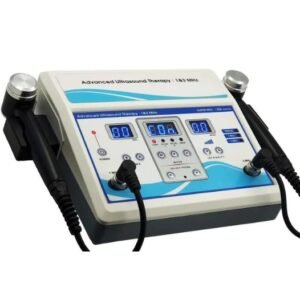
Super Pro 1 & 3 MHz Ultrasonic Therapy Machine
Model: Super Pro 1300 Digital
Quantity
Prefer a call instead? Request a callback