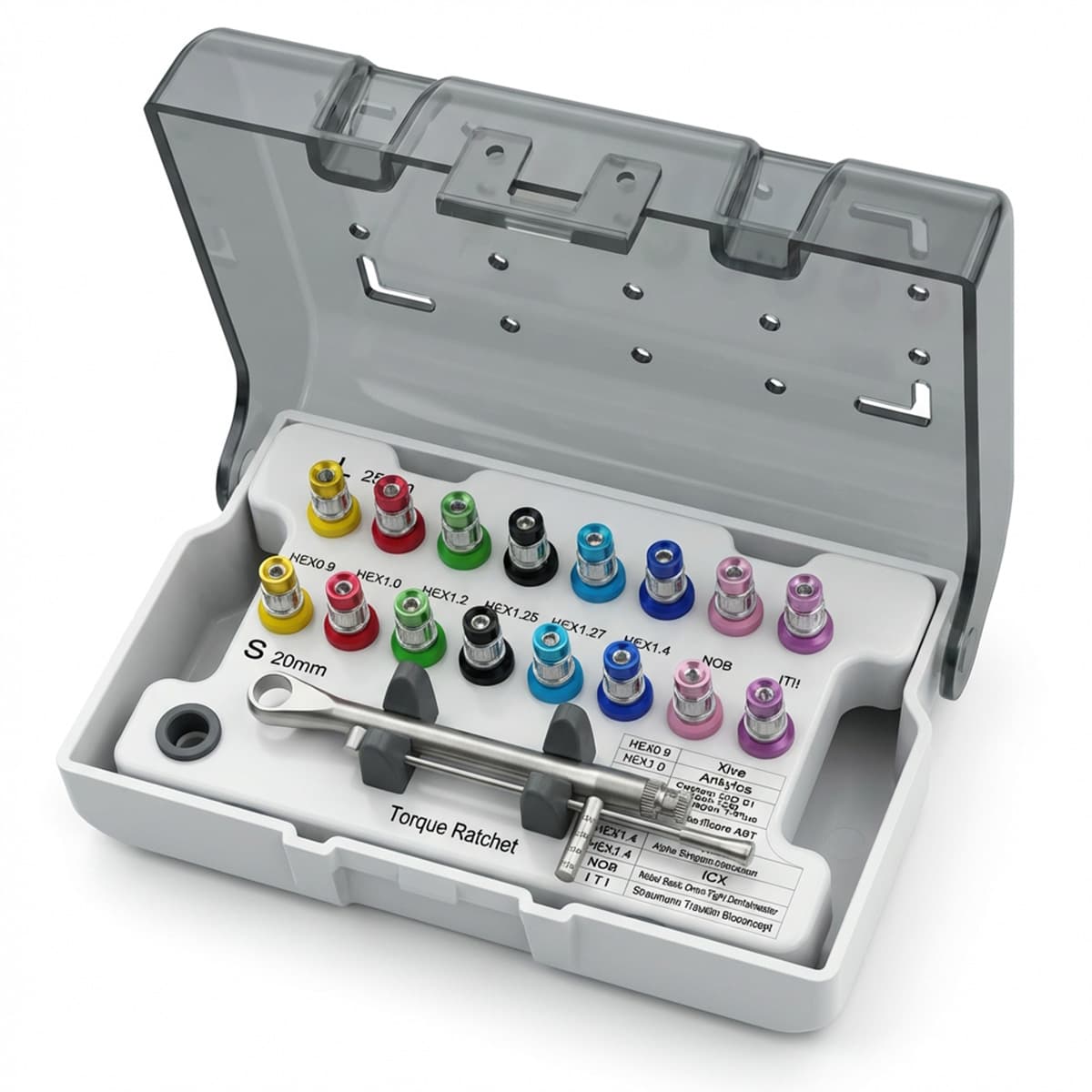
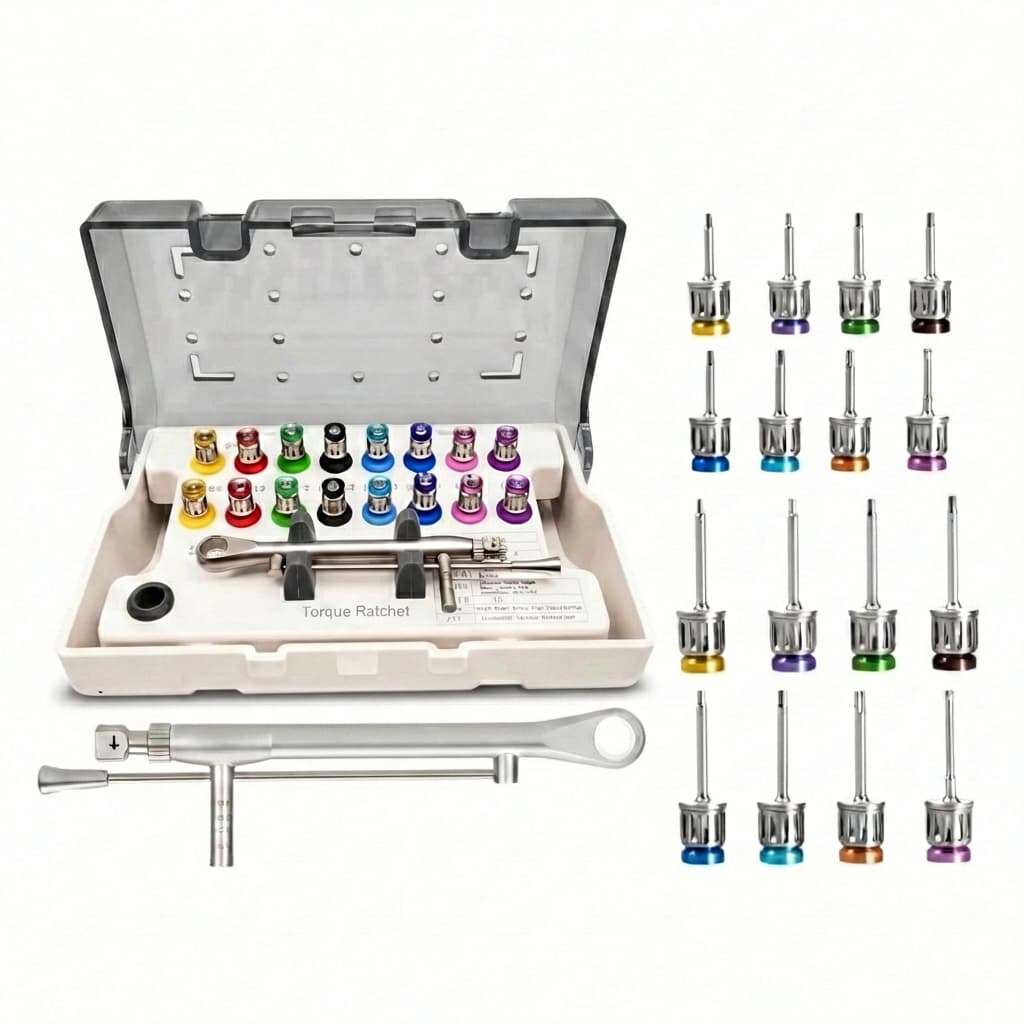
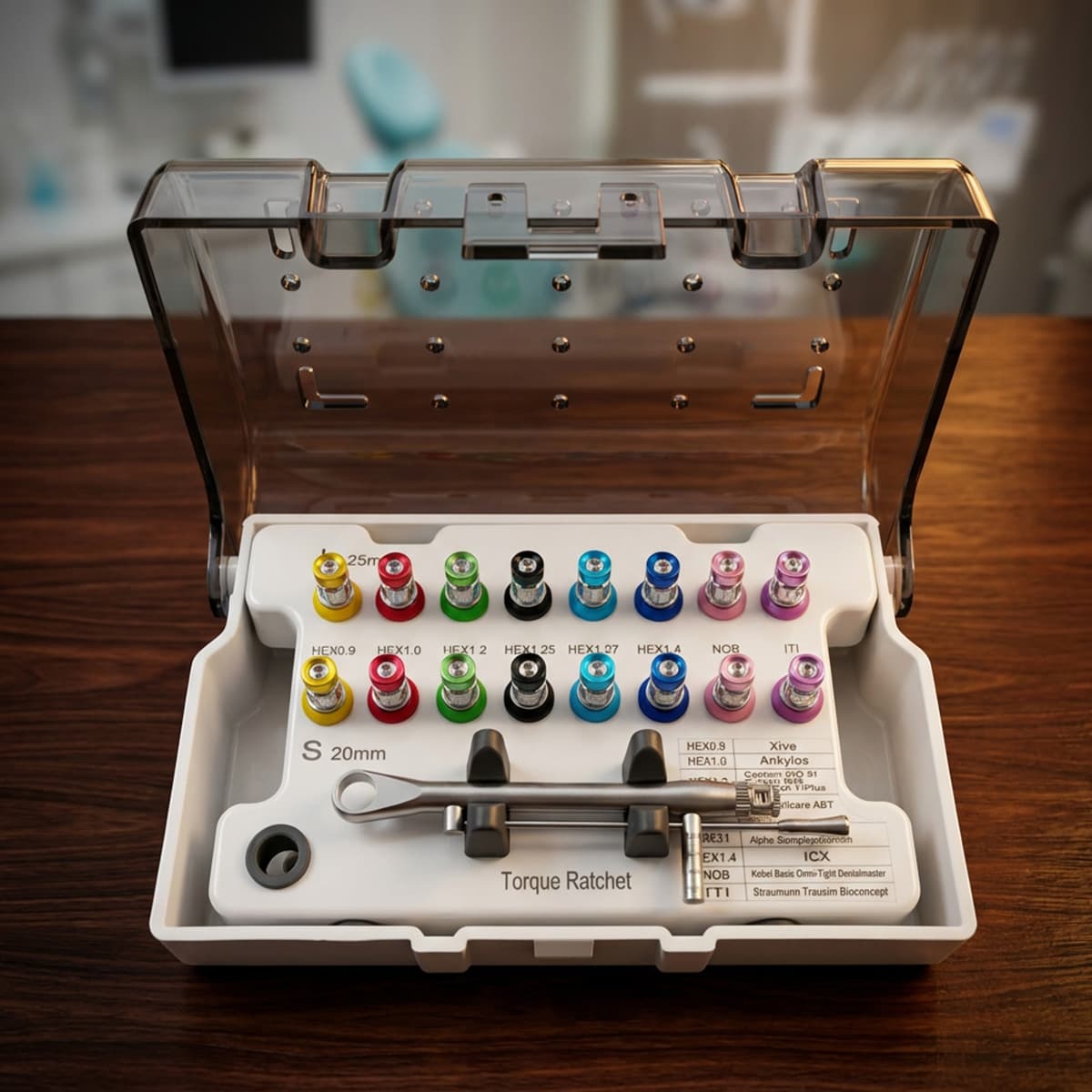
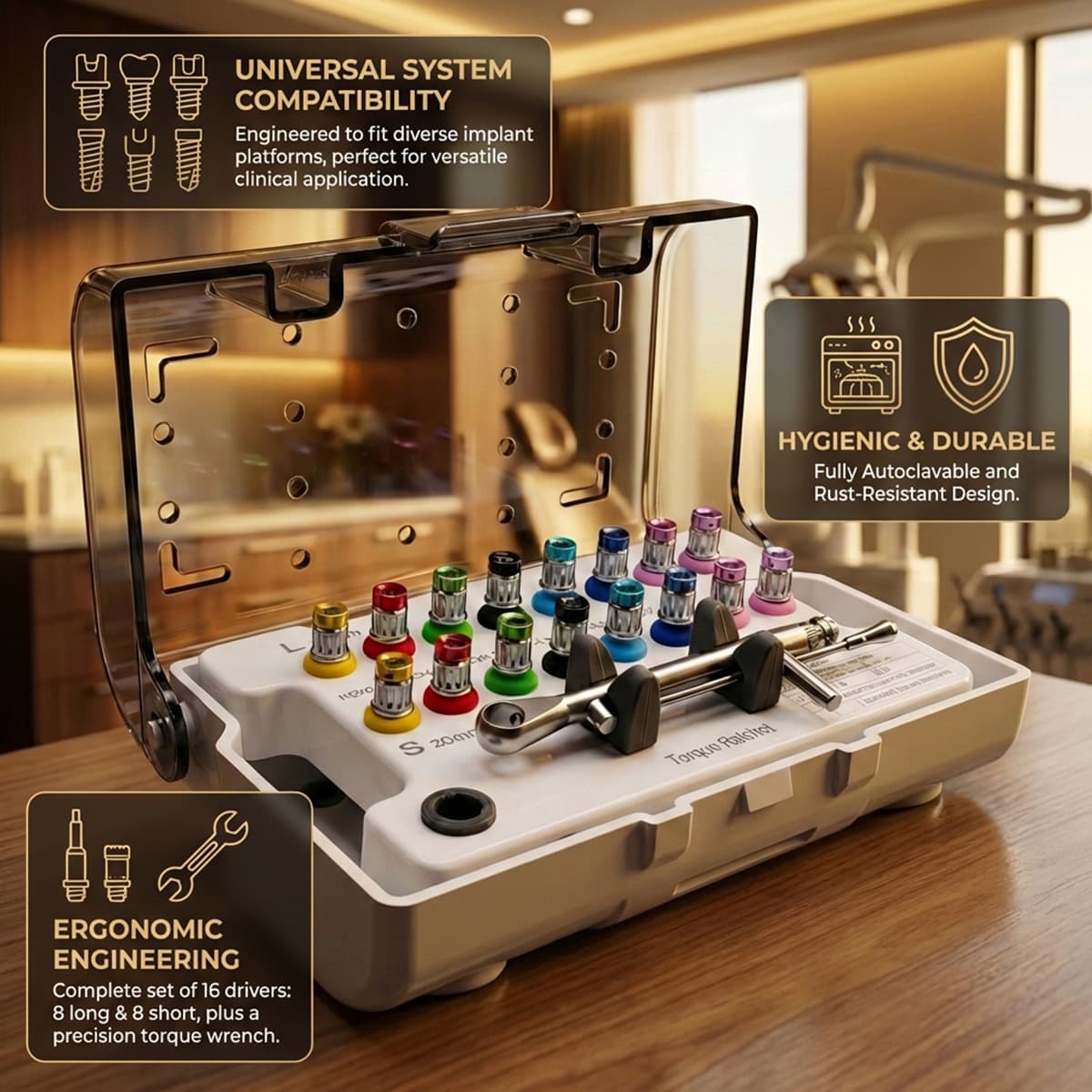
Managing multiple implant platforms within a single practice introduces instrumentation challenges. The Dentaltech prosthetic driver kit is a professional-grade clinical toolkit engineered to consolidate your restorative workflow. Designed for prosthodontists and restorative dentists, this system provides the drivers and torque mechanisms required for the precise seating of abutments and prosthetic screws across major implant brands. Maintaining brand-specific driver kits becomes inefficient and occupies valuable storage space. This universal implant driver kit resolves that logistical challenge by organizing sixteen precision-machined drivers into a single sterilization cassette.
In modern implant procedures, this kit is commonly used alongside a dental implant machine to ensure accurate implant placement and precise prosthetic restoration.
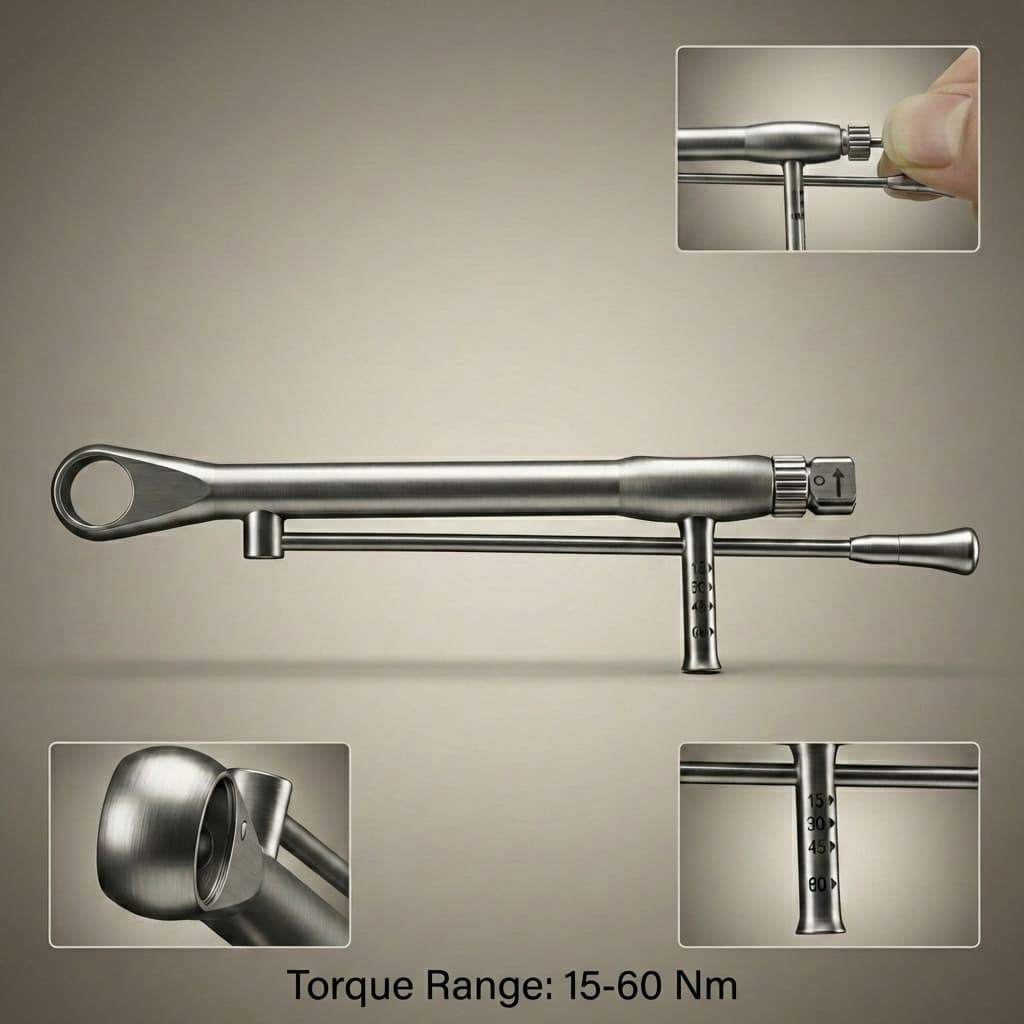
Achieving the exact manufacturer-recommended torque value is critical. Under-torquing allows bacterial microleakage, while excessive torque risks stripping internal titanium threads. The Dentaltech torque ratchet ensures accurate force application, eliminating clinical guesswork. Manufactured from high-grade martensitic stainless steel, every part is engineered to handle daily clinical use and multiple sterilization cycles. The secure friction-fit interface prevents the screw head from becoming rounded.
Product Uses
- Final Abutment Seating: Applying the exact torque to straight or angled abutments to establish a secure mechanical connection.
- Prosthetic Screw Management: Tightening and loosening clinical screws safely during the framework try-in phases.
- Routine Implant Maintenance: Utilizing this comprehensive implant driver kit to check prosthetic screws during recall appointments.
- Healing Abutment Placement: Securely placing healing caps during second-stage uncovery surgeries.
- Impression Coping Stabilization: Attaching open and closed tray impression copings firmly to the fixture for accurate spatial transfer.
- Laboratory Benchwork: Using manual drivers on laboratory analogues to build and check the passive fit of custom frameworks.
- Component Salvage Operations: Removing worn prosthetic parts from legacy implant systems where original tools are unavailable.
How to Use
Step 1: Clinical Identification and Selection
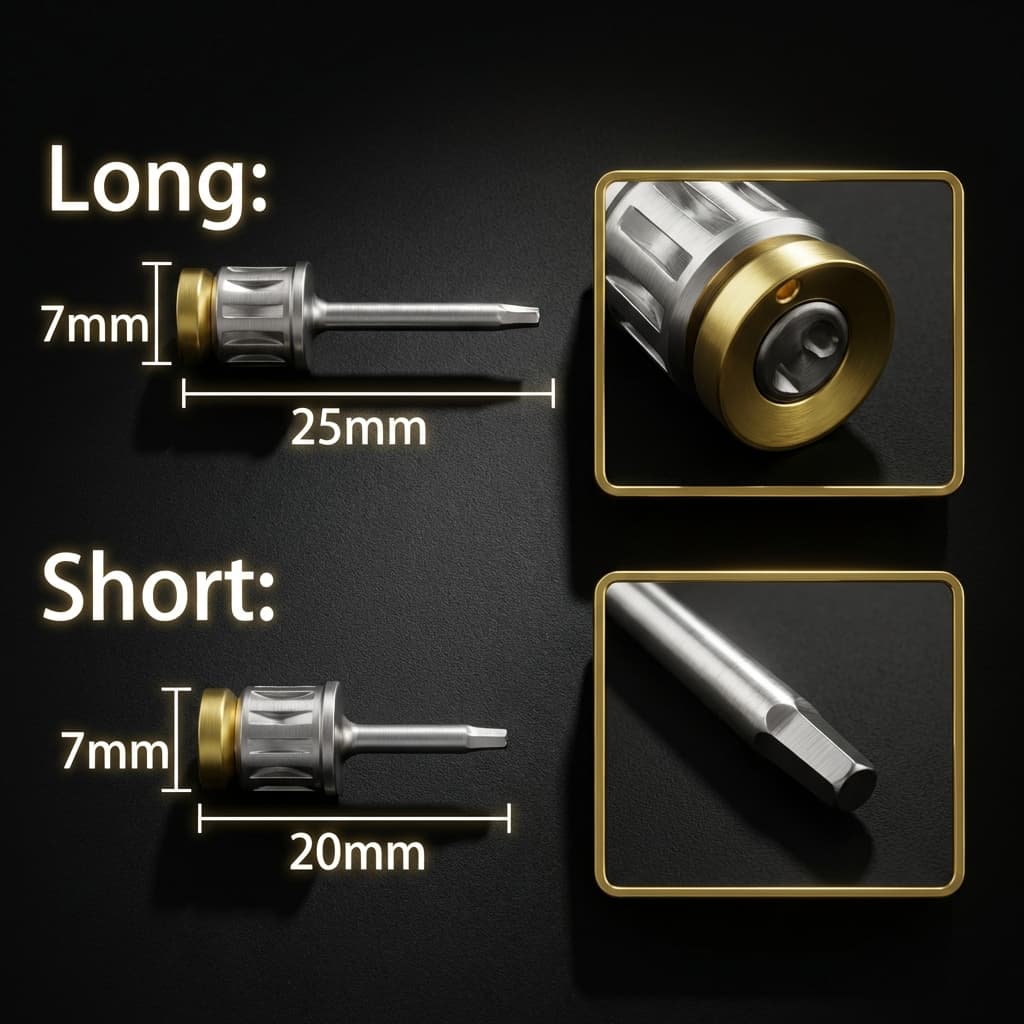
Check the patient treatment plan to confirm the correct implant system and platform diameter. Use the colour-coded band on the shanks of the universal dental implant driver kit to choose the exact hex or speciality driver profile. Pick the 20mm short driver for posterior areas, or the 25mm long driver for anterior areas.
Step 2: Driver Engagement
Insert the selected driver tip directly into the head of the prosthetic screw. Check by tactile feedback that the driver is completely seated. A good friction fit keeps the driver from slipping or damaging the titanium screw head.
Step 3: Torque Ratchet Assembly
Put the shank of the chosen driver into the receiving head of the calibrated torque ratchet. Make sure the driver fits snugly into the wrench retention mechanism so it does not detach.
Step 4: Torque Application
Keep the handle parallel to the occlusal plane to avoid off-axis loading. Put steady, slow pressure on the handle clockwise. Stop applying pressure immediately upon reaching the desired Newton centimetre specification, indicated by a mechanical click.
Step 5: Verification and Disassembly
Check that the abutment or prosthesis is completely in place and does not move. Take the torque ratchet off the driver and place the driver on the sterile surgical tray for processing.
Step 6: Prosthetic Removal
When managing recalls or component salvage, insert the correct driver, ensure a snug fit, and carefully rotate the ratchet or manual driver counter-clockwise to loosen and safely remove the prosthetic screw.
Product Features
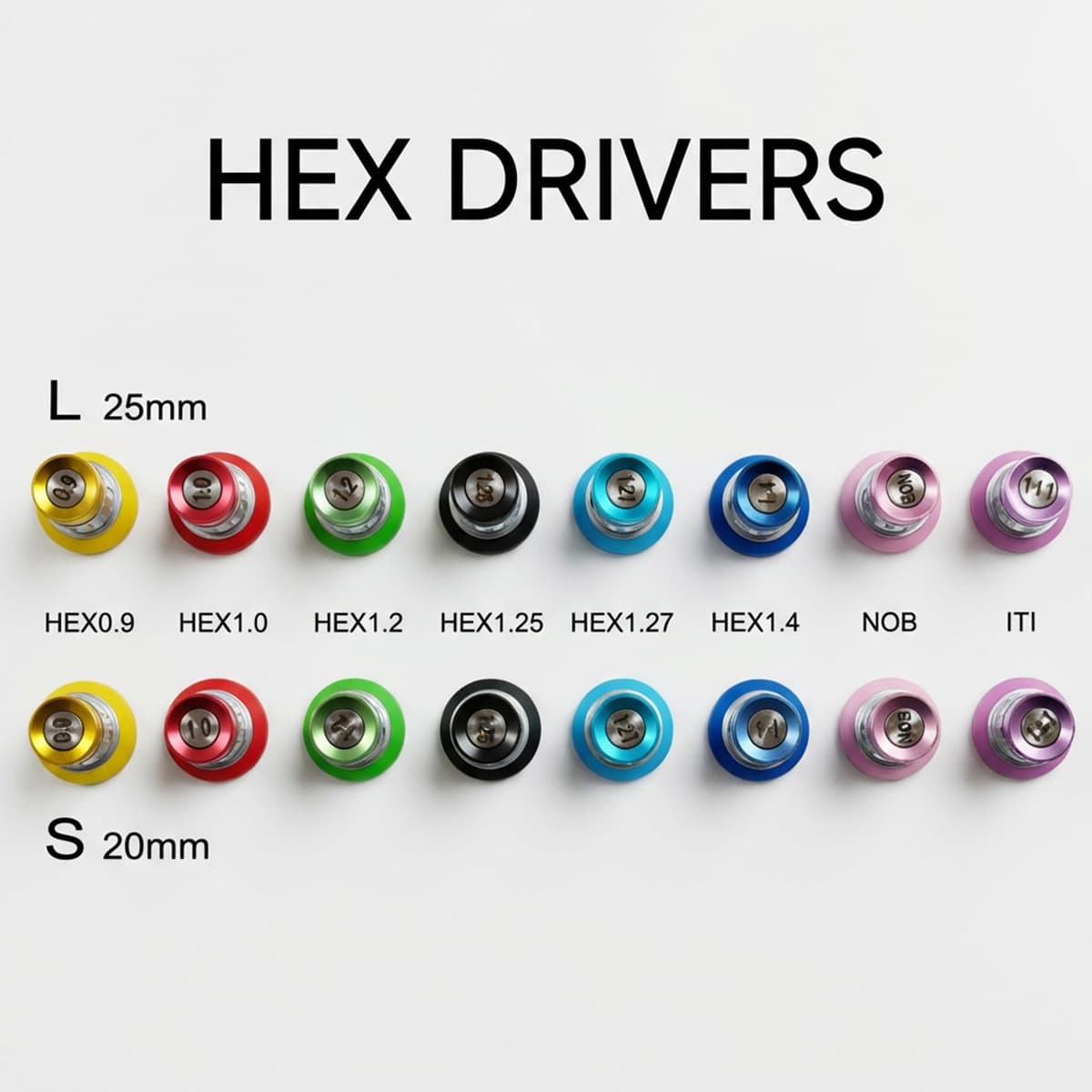
- Extensive Profile Compatibility: The prosthetic driver kit comes with hex sizes including 0.9, 1.0, 1.2, 1.25, 1.27, and 1.4, plus speciality profiles for NOB and ITI connections.
- Calibrated Torque Control: Features an accurate torque ratchet mechanism that delivers the measurable force required to safely tighten screws.
- Dual Length Choices: Provides short drivers of 20mm and long drivers of 25mm to accommodate different patient anatomies.
- Visual Color Coding: Each driver shank has an anodised colour band, making it easy to find the right tip instantly.
- Premium Material Construction: Made from high-quality autoclavable surgical stainless steel, resisting corrosion and maintaining dimensional stability.
- Precision Machined Interfaces: Designed with microscopic tolerances to make sure the instrument and titanium hardware fit perfectly.
- Optimized Clinical Organization: The universal prosthetic kit comes in a protective cassette, keeping all parts secure and ready for surgical use.
- Ergonomic Handling: The torque ratchet features a slip-resistant, ergonomic handle design that reduces hand fatigue and ensures a comfortable, controlled grip during complex or extended restorative procedures.
Technical Specification
| Specification | Detail |
| Material Composition | High-grade martensitic surgical stainless steel |
| Short Driver Length | 20mm |
| Long Driver Length | 25mm |
| Hex Driver Sizes | 0.9, 1.0, 1.2, 1.25, 1.27, 1.4 |
| Specialty Driver Profiles | NOB, ITI |
| Torque Delivery System | Calibrated mechanical ratchet wrench |
| Sterilization Compatibility | Fully autoclavable up to 134°C (273°F) |
| Identification Method | Anodized color coding on instrument shanks |
| Case Type | Perforated sterilization and storage cassette |
Handling Tips
To get the longest lifespan out of your driver kit, you must follow strict maintenance protocols.
- Immediately after the clinical procedure, take apart the torque ratchet according to the manufacturer's instructions. Use a nylon bristle brush under cold running water to remove visible biological debris.
- Place the parts in a pH-neutral enzymatic cleaning solution and run them through an ultrasonic cleaner. Do not use strong chemical disinfectants with high chlorine concentrations, as they cause microscopic pitting on stainless steel.
- Dry the instruments completely using compressed air before returning them to the case. Follow standard class B cycles to sterilize the assembled case in a steam autoclave at 134 degrees Celsius.
- Every twelve months, send the torque ratchet to a certified facility to be recalibrated, ensuring the mechanical spring delivers accurate values.
Product Packaging
- 1 x Calibrated Torque Ratchet Wrench
- 1 x Protective Organized Clinical Storage Cassette
- 8 x Large Hex Drivers (25mm length): Hex 0.9, 1.0, 1.2, 1.25, 1.27, 1.4, NOB, ITI
- 8 x Small Hex Drivers (20mm length): Hex 0.9, 1.0, 1.2, 1.25, 1.27, 1.4, NOB, ITI
Medical Disclaimer
Only licensed dentists, prosthodontists, and trained clinical staff should use this product. Proper training in modern implant dentistry and restorative torque protocols is required. Applying the incorrect amount of torque or selecting the wrong driver profile could fracture a titanium component, strip an internal screw, or injure the patient. Always check the specific implant manufacturer's guidelines to verify exact torque values before starting restorative treatment.
Warranty / Support
The manufacturer offers a full one-year warranty on the Dentaltech Universal Prosthetic Driver Kit, covering defects in materials or workmanship during normal clinical use. The warranty does not cover damage due to incorrect sterilization procedures, dropping components, or using the torque wrench beyond its mechanical capacity. For technical assistance or replacement parts, please contact customer support using the information in your order confirmation.
Certifications
This complete set of instruments is manufactured to meet strict international medical device standards. The facility is ISO 13485 certified to design and produce medical devices. The CE mark on the components shows full compliance with European health, safety, and environmental protection standards.
FAQ
Q: Which implant systems can the 1.25 and 1.27 hex drivers work with?
A: The 1.25 hex driver works with systems like Zimmer, BioHorizons, and Implant Direct. The 1.27 hex driver fits Dentium and standard internal hex platforms. Verify exact compatibility with the manufacturer before applying torque.
Q: How often should the torque ratchet in this universal driver kit undergo calibration?
A: The mechanical torque ratchet should be tested and recalibrated every twelve months to maintain clinical accuracy. High-volume clinics should calibrate every six months.
Q: Do the driver tips in this dental implant screwdriver set have magnets in them?
A: No. They are machined from high-quality surgical stainless steel and rely on precise friction fit engineering to securely hold the prosthetic screw.
Q: Can the whole organized storage case go straight into the autoclave?
A: Yes. The storage cassette is manufactured for sterilization workflows. Place it directly into a steam autoclave with all tools inside, provided every component is thoroughly ultrasonically cleaned and dried first.
Q: Does this prosthetic driver kit come with parts for external hex systems?
A: Yes. The kit includes the NOB driver profile, engineered to work with screws used in standard Branemark-style external hex platforms.
Q: What is the main difference between the 20mm and 25mm drivers that come with the kit?
A: The 20mm drivers are designed for posterior access when vertical mouth opening is limited. The 25mm-long drivers are perfect for anterior restorations or for deeply subgingival implant platforms.
Q: Can I buy separate replacement tips for this toolkit?
A: Yes. If a driver tip reaches the end of its mechanical lifespan, you can purchase a replacement from an authorized distributor without buying the whole kit again.
Conclusion
The Dentaltech prosthetic driver kit provides a dependable, streamlined solution for restorative professionals managing wide-ranging implant cases. This comprehensive kit makes chairside procedures efficient and boosts clinical confidence by delivering precision-machined drivers alongside a reliable torque delivery system. Investing in high-quality universal instruments lowers the risk of component fracture and ensures your dental practice adapts easily to the demands of modern implant dentistry.