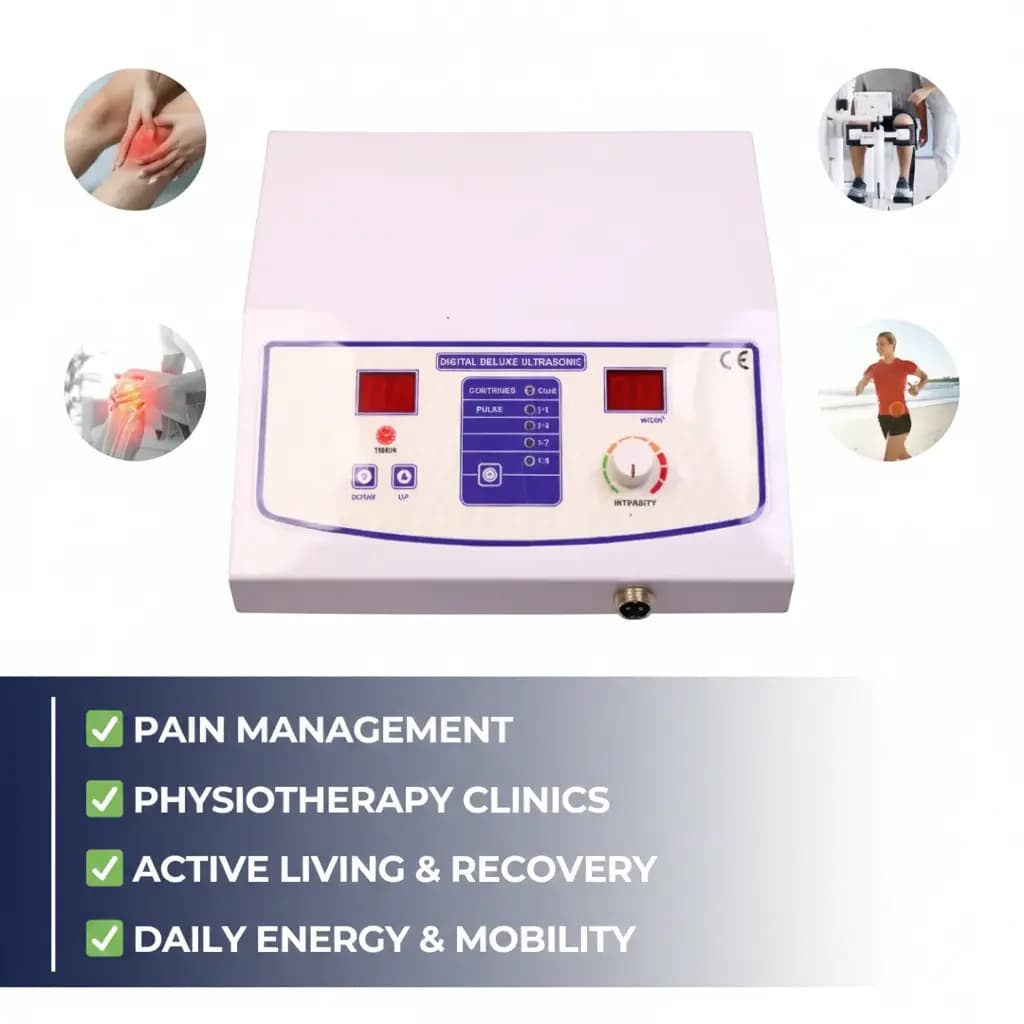
The ultrasound muscle strain device is a 3 MHz ultrasonic therapy device designed for superficial soft tissue applications. It is suitable for tendons, ligaments, small joints, and localized muscle rehabilitation in professional and supervised home settings.
At a Glance
| Specification | Details |
| Product Name | Portable 3 MHz Ultrasonic Physiotherapy Machine |
| Device Type | Therapeutic Ultrasound Therapy Device |
| Frequency Type | Single Frequency (3 MHz) |
| Probe Type | 3 MHz Ultrasound Transducer |
| Output Control | Adjustable Intensity Control |
| Control Interface | Digital Buttons & Rotary Intensity Knob |
| Output Connection | Side O/P Probe Port |
| Power Supply | 110V / 220V AC, 50/60 Hz |
| Intended Application | Therapeutic Ultrasound for Superficial Soft Tissue |
Certifications
This ultrasound device for muscle strain is supported by CE and ISO 13485 certification documentation, demonstrating compliance with recognized quality management and safety standards for therapeutic ultrasound equipment.
Key Features
- 3 MHz superficial therapy: Targets tissues up to approximately 2–3 cm beneath the skin.
- Continuous & Pulsed modes: Supports both thermal and non-thermal therapeutic ultrasound applications.
- Four pulse ratios: Selectable 1:1, 1:4, 1:7 and 2:0 duty cycles for different therapy requirements.
- Dual LED displays: Separate displays for treatment time and output intensity.
- Adjustable intensity: Smooth rotary control for precise output adjustment.
- Compact & portable: Suitable in clinics and supervised home settings.
- Phonophoresis compatible: Supports ultrasound-assisted topical medication delivery under professional guidance.
- Simple control panel: Suitable for handheld ultrasound therapy applications requiring controlled treatment of soft tissues under professional guidance.
Treatment Guide
| Condition / Therapy Goal | Typical Application |
| Muscle Strain | Targeted ultrasound for muscle strain under professional guidance |
| Tendinitis & Tendinopathy | Therapeutic ultrasound for superficial tendon rehabilitation |
| Ligament Sprains | Supports soft tissue recovery and rehabilitation |
| Plantar Fasciitis | Therapeutic ultrasound for heel and foot soft tissues |
| Frozen Shoulder | Helps improve soft tissue flexibility and joint mobility |
| Small Joint Stiffness | Supports rehabilitation of the wrist, hand, ankle, and foot joints |
| Scar Tissue Management | Supports superficial soft tissue remodeling during rehabilitation |
| Post-operative Rehabilitation | Part of supervised physiotherapy recovery programs |
| Localized Soft Tissue Pain | Supportive therapeutic ultrasound for superficial tissues |
| Phonophoresis | Ultrasound-assisted topical medication delivery when clinically appropriate |
Control Panel Functions:
| Control / Component | Function & Description |
| TIMER Display (Left LED) | Red LED countdown showing remaining treatment time in minutes. |
| TIMER ▼ ▲ Buttons | Down/Up push-buttons to set treatment duration before starting. |
| Mode Selector Panel (Blue) | Central blue panel housing mode selection. Press CONTINUOUS for uninterrupted output, or PULSE and then select ratio 1:1, 1:4, 1:7 or 2:0. |
| M.SELECT Button | Mode select confirm/cycle button—used to activate the highlighted mode or cycle through pulse options. |
| INTENSITY Display (Right LED) | Red LED showing live output power in W/cm² during treatment. |
| INTENSITY Knob (Blue Rotary) | Large blue rotary knob — turn clockwise to increase intensity from 0.1 up to 3 W/cm². |
| O/P Jack (Side Panel) | Probe the output connection port on the side panel. Connect the transducer probe before powering on. |
Pulse Ratio Guide:
| Ratio | On-Time % | Off-Time % | Clinical Application |
| 1:1 | 50% | 50% | Sub-acute injuries, moderate thermal effect, general soft tissue |
| 1:4 | 20% | 80% | Acute injuries, reduced thermal accumulation, and oedema management |
| 1:7 | 12.5% | 87.5% | Highly acute/sensitive—near-athermal mechanical effects only |
| 2:0 | Device-Specific Setting | Device-Specific Setting | Specialized pulse setting available on the device; use according to the recommended treatment protocol and practitioner guidance |
How to Use
- Prepare the treatment area: Clean the skin and apply a generous layer of ultrasound coupling gel.
- Set up the device: Connect the 3 MHz probe, switch on the unit, set the treatment time, and select Continuous or Pulsed mode.
- Adjust the intensity: Begin with a low intensity and increase gradually according to the recommended treatment protocol.
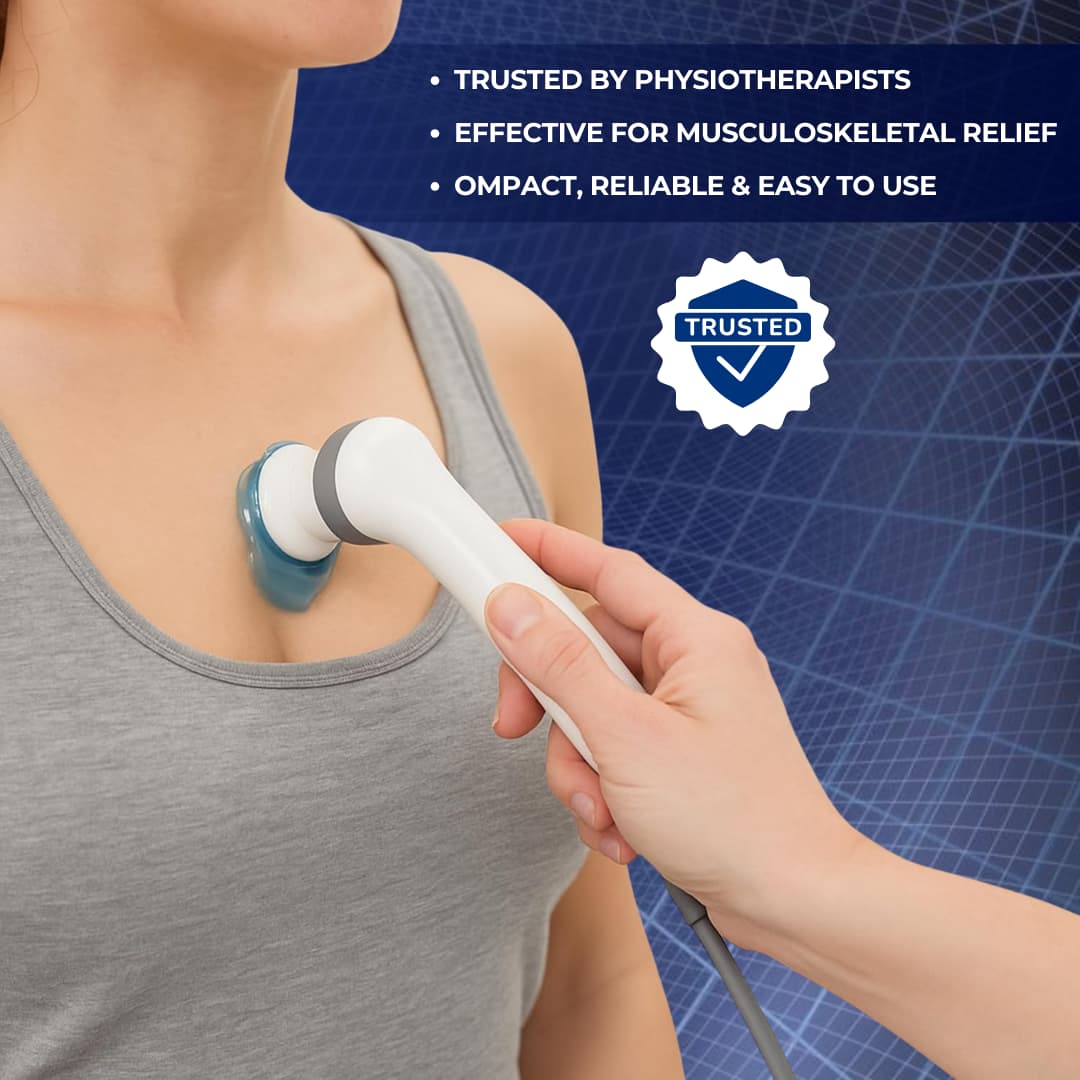
- Begin treatment: Place the probe flat against the gel-coated skin and keep it moving slowly in circular or overlapping motions throughout the session.
- Finish the session: Reduce the intensity to zero, switch off the device, clean the probe, and store it in a cool, dry place.
Contraindications
Do not use this device:
- During pregnancy, or over the abdominal or pelvic area during pregnancy.
- Over or near implanted electronic devices, including pacemakers.
- Over malignant tumors or suspected cancerous tissue.
- Over areas with deep vein thrombosis (DVT) or active thrombophlebitis.
- Over open wounds, broken skin, or active infections.
- Over the eyes, heart, spinal cord, or reproductive organs.
- Over the growth plates in children or adolescents.
- If normal sensation is impaired in the treatment area without professional assessment.
Consult a qualified healthcare professional before use if you have any underlying medical conditions or are unsure whether therapeutic ultrasound is appropriate.
Who can use this portable ultrasound machine for physical therapy?
| Suitable Users | Typical Use |
| Physiotherapists | Rehabilitation and therapeutic ultrasound |
| Rehabilitation Clinics | Soft tissue therapy programs |
| Sports Therapists | Muscle and tendon rehabilitation |
| Trained Healthcare Professionals | Therapeutic ultrasound applications |
| Adults (Supervised Home Use) | Home rehabilitation under professional guidance |
Handling & Safety
- Inspect the device, probe, and power cable for any visible damage before each use.
- Always use an approved ultrasound coupling gel during treatment. Never operate the probe on dry skin or in the air.
- Keep the probe moving continuously throughout the session to help ensure even energy distribution.
- Begin with a low intensity and adjust gradually according to the recommended treatment protocol.
- Clean the probe with a soft, damp cloth after each session and store the device in a cool, dry place.
- This portable ultrasound device for pain relief should be used in accordance with the user manual and under appropriate professional guidance.
What's in the Box
- 1 × Portable 3 MHz Ultrasonic Physiotherapy Main Unit
- 1 × 3 MHz Ultrasound Transducer Probe
- 1 × AC Power Cable
- 1 × Universal Power Adaptor
- 1 × Ultrasound Coupling Gel
- 1 × User Manual
Medical Disclaimer
This ultrasound for muscle strain device is intended for therapeutic ultrasound applications and should be used according to the user manual and under appropriate professional guidance. It is not intended to replace professional medical evaluation, diagnosis, or treatment.
Frequently Asked Questions (FAQs)
Q1. How is a 3 MHz ultrasound different from a 1 MHz ultrasound?
A 3 MHz ultrasound is generally used for superficial tissues up to approximately 2–3 cm beneath the skin, whereas a 1 MHz ultrasound is more suitable for deeper tissues. The appropriate frequency depends on the treatment area and therapeutic objective.
Q2. Is this device suitable for treating small joints?
Yes. A 3 MHz therapeutic ultrasound is commonly used for superficial structures such as the wrist, fingers, ankle, elbow, and other small joints under appropriate professional guidance.
Q3. Can I use this device after a sports injury?
Therapeutic ultrasound may be included as part of a rehabilitation program for certain sports-related soft tissue injuries. The appropriate treatment timing and settings should be determined by a qualified healthcare professional.
Q4. Can this device be used for tendon and ligament rehabilitation?
Yes. It is commonly used during supervised rehabilitation programs involving superficial tendons and ligaments, depending on the individual's condition and treatment plan.
Q5. Does this device require regular calibration or servicing?
Regular inspection of the probe, cable, and controls is recommended. If the device is not functioning correctly or has been damaged, it should be inspected and serviced by a qualified technician.
Q6. Can I use the device immediately after applying pain relief gel or cream?
Use only an ultrasound coupling gel or a coupling medium specifically recommended for therapeutic ultrasound. Ordinary creams, lotions, or cosmetic gels should not be used unless advised by a healthcare professional.
Q7. Can this device be shared between multiple users?
Yes, provided the probe is cleaned properly after each session, and appropriate hygiene practices are followed before using it on another person.
Q8. Is therapeutic ultrasound the same as a TENS machine?
No. Therapeutic ultrasound uses high-frequency sound waves to deliver energy into soft tissues, whereas TENS uses low-voltage electrical stimulation. They work through different mechanisms and may be used for different rehabilitation goals.
Q9. How long should I wait before treating the same area again?
Treatment frequency depends on the individual's condition and rehabilitation plan. Follow the schedule recommended by your physiotherapist or healthcare professional rather than repeating sessions too frequently.
Q10. Can this device replace physiotherapy sessions?
No. This ultrasonic therapy machine for pain relief is intended to complement a physiotherapy or rehabilitation program and should not replace professional medical evaluation or treatment.