YOUR PAYMENT IS SAFE. In case of a dispute (such as an order return or items not received), you can file a dispute on PayPal, as all payments are received through Paypal / credit/ Debit cardYOUR PAYMENT IS SAFE. In case of a dispute (such as an order return or items not received), you can file a dispute on PayPal, as all payments are received through Paypal / credit/ Debit cardYOUR PAYMENT IS SAFE. In case of a dispute (such as an order return or items not received), you can file a dispute on PayPal, as all payments are received through Paypal / credit/ Debit cardYOUR PAYMENT IS SAFE. In case of a dispute (such as an order return or items not received), you can file a dispute on PayPal, as all payments are received through Paypal / credit/ Debit card
Chat with us!
ShopDental

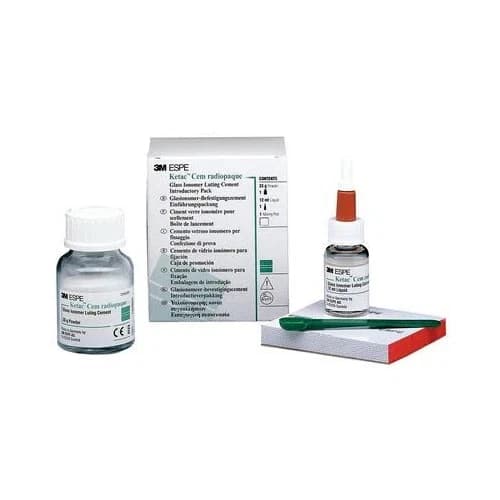
Ketac Cem Radiopaque Introductory Kit

0.0
(0 reviews)

Free Delivery

Ketac Cem Radiopaque Introductory Kit - Image 1
Ketac Cem Radiopaque Introductory Kit - Image 2
Ketac Cem Radiopaque Introductory Kit - Image 3
Ketac Cem Radiopaque Introductory Kit - Image 4
Ketac Cem Radiopaque Introductory Kit - Image 1
Preview
Ketac Cem Radiopaque Introductory Kit - Image 2
Preview
Ketac Cem Radiopaque Introductory Kit - Image 3
Preview
Ketac Cem Radiopaque Introductory Kit - Image 4
Preview
$45.00 USD$55.00(18% off)

Key Highlights.


  1. Low film thickness
  2. Radiopaque
  3. Fluoride release
  4. Working time (including mixing): 3:30 min
  5. Setting time (from begin of mix): 7:00 min.
  6. High level of biocompatibility
  7. Simple and user-friendly cementation material


Quantity:

In Stock

Pay with confidence:

Product Information

3M Ketac Cem Radiopaque is a conventional powder/liquid glass ionomer luting cement developed by 3M ESPE for permanent cementation of a wide range of indirect dental restorations. It has been in clinical use for decades, and the radiopaque formulation addresses a specific limitation of the original material by making the cement clearly visible on periapical and bitewing radiographs. This is a meaningful clinical improvement because it allows practitioners to verify margin placement, detect cement overhangs, and monitor the restoration interface during routine follow-up radiographic assessments.

The setting reaction is a straightforward acid-base process between the glass powder and the polyacrylic acid in the liquid. Once set, the cement reaches a neutral pH and exhibits a stable bond to both enamel and dentin through ionic exchange. This bond forms without the need for light curing, etching, or a separate adhesive primer, which keeps the cementation sequence simple and reduces technique sensitivity.

3M ESPE Ketac Cem is well-suited for general dental practice and specialist settings alike. It performs reliably under crowns, bridges, inlays, onlays, posts, and orthodontic bands, and the sustained fluoride release over time contributes to caries inhibition at the restoration margin. The introductory kit is a complete, ready-to-use package that contains all dispensing and mixing accessories required to begin work immediately.

Product Uses

  1. Cementation of cast metal inlays and onlays: The low film thickness of this cement ensures full seating of indirect restorations without interference from excess material at the margins. It is well-suited for situations where marginal accuracy is critical.
  2. Crowns and fixed partial dentures (metal, PFM, all-zirconia, all-alumina): 3M Ketac Cem Radiopaque is cleared for use under all major crown and bridge substrate types. Its mechanical properties are sufficient for long-span bridges, which makes it a practical choice across a wide prosthetic case load.
  3. Post and screw cementation: The cement's flow characteristics allow it to distribute evenly throughout the canal preparation. It provides reliable retention for both prefabricated and custom-cast posts in endodontically treated teeth.
  4. Orthodontic band cementation: Ketac cem luting cement has a well-established record in orthodontic practice. The sustained fluoride release provides a measurable protective effect on enamel under and around band margins throughout the treatment period.
  5. Cavity lining: Where a base or liner is needed beneath an indirect restoration, this cement can serve that function prior to the final cementation step.
  6. Pediatric crown cementation: Its biocompatibility, fluoride release, and ease of cleanup make it appropriate for cementing stainless steel and zirconia pediatric crowns.


How to Use

  1. Before mixing, complete all tooth preparation steps. Check the fit, contacts, and occlusion of the restoration during a dry try-in. At this point, make any necessary changes to the occlusion or contact.
  2. If you want better adhesion to dentin, condition the preparation with 10% polyacrylic acid for 10 seconds. You don't have to do this step. Rinse well and then blot dry with a cotton ball, being careful not to dry out the dentin.
  3. Put the powder and liquid on the mixing pad. A normal powder-to-liquid ratio is 1.8 g of powder to 0.8 mL of liquid. To make sure you get the same amount every time, use the measuring spoon and dropper that came with the kit.
  4. Use a folding spatulation method to mix all of the powder into the liquid. Finish mixing in 30 seconds. At 23 degrees Celsius, the whole time spent working, including mixing, is around 3 minutes and 30 seconds. This working window will decrease if the room temperature is higher.
  5. Put a thin, even coat of the mixed cement on the inside of the restoration. Do not overfill, as excess material will prevent complete seating and compromise the marginal fit.
  6. Seat the restoration with steady, even pressure and hold it in place until the initial set. Use a scaler or dental floss to remove any excess cement from the margins during the gel stage, before it sets completely.
  7. Do not disturb the restoration while it is setting. It takes around 7 minutes for the mixture to set at 23 degrees Celsius. Check the occlusion with articulating paper after it has fully set, and only make adjustments where needed. Avoid finishing the cement margins too aggressively right away.

Product Features

  1. Radiopacity: Both traditional and digital X-rays can tell the difference between cement, tooth structure, and restoration material. This makes it easier for doctors to see post-operative margins and overhangs and read radiographs.
  2. Sustained fluoride release from the cement matrix: This greatly lowers the incidence of secondary caries around the edge of the restoration, which is crucial for people who are at moderate to high risk.
  3. Low film thickness: The film thickness is always less than 25 microns, which is what ISO 9917-1 says it should be for luting cement. This makes sure that restorations fit perfectly into the preparation depth without any differences at the edges caused by cement.
  4. Because of its ionic bonding technique, this 3M glass ionomer luting cement chemically bonds to calcium in enamel and dentin without etching or priming. This reduces the amount of microleakage between the cement and the tooth compared to zinc phosphate.
  5. The acid-base setting reaction that doesn't need light curing is self-contained. There is no priming, bonding agent, or curing step. This makes the process easier and less likely to go wrong.
  6. Working time for complicated cases gives you 3 minutes and 30 seconds to load, seat, and position restorations in difficult clinical situations.
  7. Good for long-span bridges: This 3m glass ionomer Ketac luting cement is stronger than other materials when it comes to compression and tension, so it can be used for longer fixed prostheses.
  8. This material is safe to use with pulpal tissue. Once it has set, its pH levels return to normal, and it meets ISO 9917-1 for water-based cements.
  9. Simple powder/liquid distribution system: The two-part style lets you change the consistency of the mix slightly for different uses. A thicker combination is preferable for luting because it has more viscosity. A thinner mix is better for lining.


Technical Specifications


SpecificationDetail
Product NameKetac Cem Radiopaque Introductory Kit
Manufacturer3M ESPE
TypeConventional Powder/Liquid Glass Ionomer Luting Cement
Powder CompositionGlass powder, Polycarboxylic acid, Water
Liquid CompositionTartaric acid, Pigments, Conservation agents
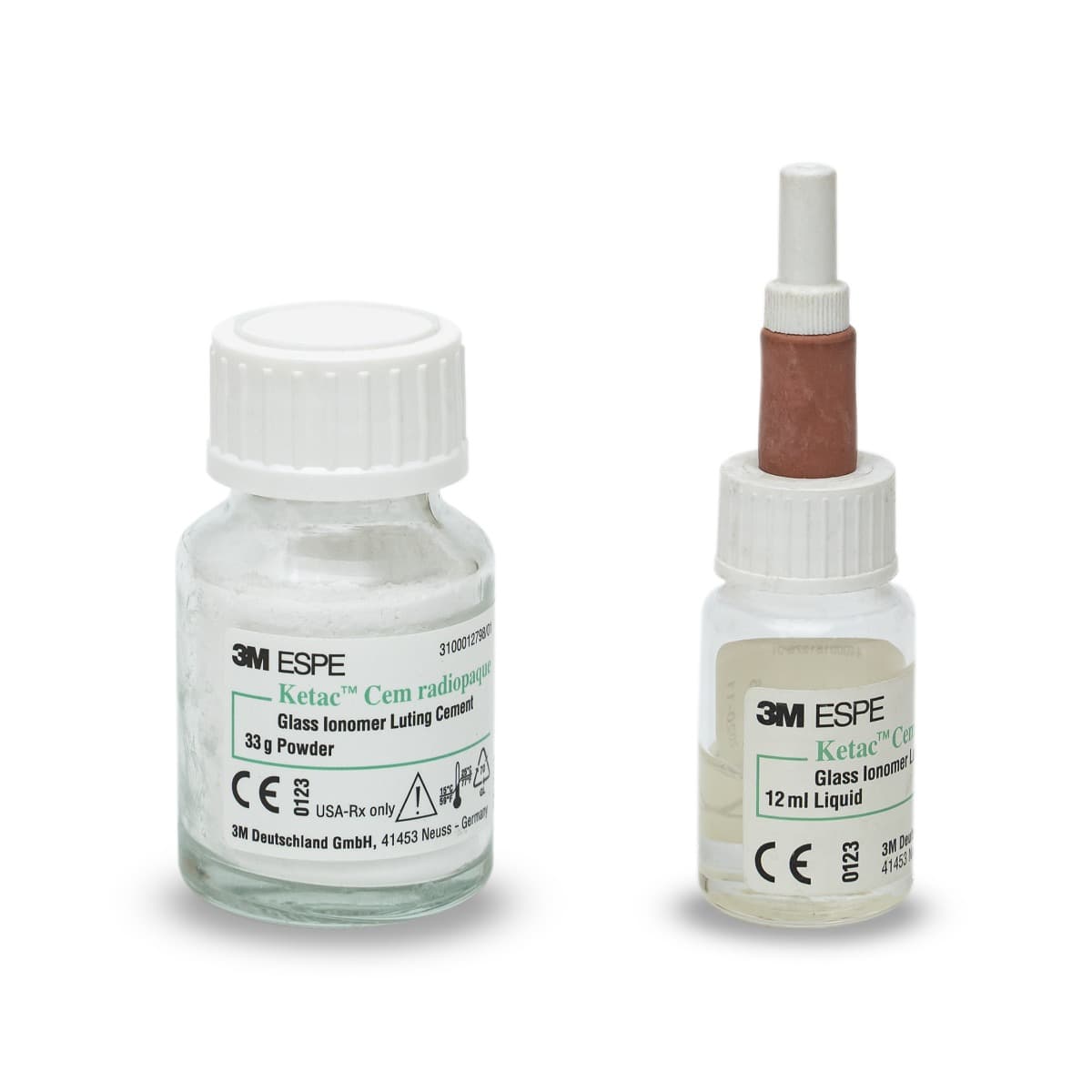
Powder Weight33 g
Liquid Volume12 mL
Working Time (incl. mixing)Approx. 3 min 30 sec at 23 degrees C
Setting Time (from start of mix)Approx. 7 min at 23 degrees C
Film ThicknessLess than 25 microns
RadiopacityYes
Fluoride ReleaseYes (sustained)
ISO ComplianceISO 9917-1
ShadeTranslucent / Yellow tint
Standard P/L Ratio1.8 g powder / 0.8 mL liquid


Handling Tips

  1. Keep the powder and liquid in a cool, dry place that doesn't get direct sunlight. The best temperature for storage is between 2 and 25 degrees C. Don't freeze the liquid because it changes the polymer structure and changes the setting reaction.
  2. Right after you pour out the liquid, put the cap back on the bottle. When the liquid is exposed to air for a long time, the water evaporates, which makes the acid stronger and changes how the mix can be handled.
  3. Dispense the powder and liquid immediately before mixing. When you pre-dispense and leave the components on the pad for a long time, the powder can absorb moisture, and the liquid can evaporate. Both of these things change the P/L ratio and the final properties. 
  4. Only use the spoon that comes with the kit to measure the powder. This makes sure that the dispensing ratio is the same for all mixes and operators.
  5. If you need to extend your working time, you can mix the cement on a chilled glass slab. However, ensure the slab is completely dry and above the dew point, as condensation will alter the water content of the mix and compromise the cement.
  6. Always keep the powder dry. When the material comes into contact with moisture or liquid in the bottle, it sets too soon and cannot be used.
  7. Before putting on the cement for orthodontic bands, make sure that the inside of the band is clean and free of any lubricant, separating medium, or other dirt.
  8. Follow your area's rules for throwing away used mixing pads and leftover cement. Most of the time, fully set glass ionomer cement is considered solid dental waste.

Product Packaging

Each introductory kit contains the following components:

  1. 1 x 33 g Powder bottle
  2. 1 x 12 mL Liquid bottle
  3. 1 x Dropper
  4. 1 x Measuring Spoon
  5. 1 x Mixing Pad


Medical Disclaimer

This product is intended for use by licensed dental professionals only. The information provided in this listing is for reference purposes and does not constitute clinical advice or replace the full Instructions for Use (IFU) issued by 3M ESPE. Practitioners should review the current IFU before clinical application, as specifications and recommendations may be updated by the manufacturer. Clinical outcomes depend on patient selection, preparation design, material handling, and operator technique. The seller bears no liability for outcomes resulting from improper use of this product.

Warranty / Support

This product is sold as an authentic 3M ESPE item. The seller guarantees product authenticity and offers returns in accordance with the store's return policy. Shipment issues, damaged products, or non-receipt cases are handled through the payment platform's resolution process. For technical questions regarding product performance or clinical application, practitioners may contact 3M ESPE directly through their regional dental products division or refer to the 3M dental professional support portal.

Certifications

3M Ketac Cem Radiopaque complies with ISO 9917-1 for dental water-based cements. It is CE marked for use in the European Union and holds regulatory clearance in multiple global markets, including US FDA clearance. All 3M ESPE dental materials are manufactured under quality management systems certified to ISO 13485, which covers the design and manufacture of medical devices.

FAQ

Q1: Can this cement be used under zirconia crowns?

Yes, ketac cem radiopaque 3m is fully compatible with all-zirconia and all-alumina restorations. While sandblasting the internal surface enhances mechanical retention, the cement's natural ionic adhesion works effectively without it.

Q2: Does this cement require light curing?

No, light curing is not required for this formulation. The setting reaction is entirely self-curing through an acid-base mechanism.

Q3: How does working time vary with temperature?

The standard 3.5-minute working time applies at 23°C, but higher room temperatures will significantly reduce this window. In warm clinical environments, it is advisable to mix on a chilled glass slab to extend your working time.

Q4: Is this cement suitable for cementing fiber posts?

Yes, it can be safely used for fiber post-cementation. However, resin-based luting agents are generally preferred if maximum bond strength in the apical third of the root canal is your top priority.

Q5: Is the radiopacity detectable on digital radiographic sensors?

Yes, the radiopaque formulation provides excellent contrast for clear visibility. It is easily detectable on both conventional X-ray films and modern digital sensors.

Q6: What is the shelf life of this product?

The shelf life is typically 24 months from the date of manufacture when stored between 2°C and 25°C. Always check the printed expiry date on the product packaging before use.

Q7: Can this cement be used in pediatric dentistry?

Yes, its excellent biocompatibility, fluoride release, and easy cleanup make it highly suitable for pediatric dentistry. It is routinely used for cementing stainless steel and pediatric zirconia crowns.

Conclusion

For dental practitioners who require a reliable, low-complexity luting cement with a well-established clinical record, 3M Ketac Cem Radiopaque continues to be a solid choice. The radiopaque formulation resolves the one significant limitation of the conventional version by making the cement identifiable on radiographs, which is important for post-operative verification and long-term monitoring. Its combination of fluoride release, chemical adhesion to tooth structure, low film thickness, and compatibility with a broad range of restoration materials means it fits naturally into most cementation workflows without requiring additional materials or procedural steps. The 3M ESPE Ketac Cem introductory kit provides everything needed for immediate use, making it an accessible and practical option for both general and specialist dental practice.


Ratings & Reviews

No Reviews Yet

Be the first to share your thoughts about this product! Your review will help other customers make informed decisions.

Share your experience with this product