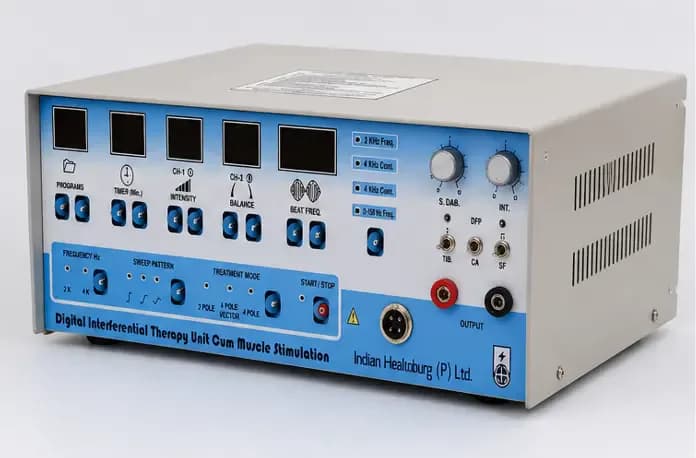
The Interferential Therapy and Stimulator is an interferential stimulator and professional electrotherapy machine used for interferential therapy and electrical stimulation treatments in physiotherapy and rehabilitation settings. It features dual-channel output, multiple therapy modes, and adjustable treatment settings for different clinical applications. The device is commonly used in physiotherapy clinics, hospitals, rehabilitation centers, and sports medicine facilities. Its straightforward controls and dependable performance make this IFT therapy machine a practical choice for routine clinical use.
Product Uses
- Pain Management Programs: Commonly used as part of physiotherapy and rehabilitation programs involving acute and chronic pain in different areas of the body.
- Neuromuscular Rehabilitation: Frequently incorporated into therapy programs focused on muscle stimulation, neuromuscular re-education, and functional recovery following injury.
- Post-Surgical Rehabilitation: Often used in rehabilitation settings as part of recovery programs following surgery and soft tissue injury.
- Sports Injury Recovery: Commonly included in rehabilitation programs involving sports-related injuries, muscle strains, and soft tissue conditions.
- Muscle Conditioning Programs: This electrical stimulator machine is commonly incorporated into rehabilitation and conditioning programs under professional supervision.
- Professional Clinical Use: Suitable for physiotherapy clinics, rehabilitation centers, hospitals, sports medicine facilities, and other professional healthcare environments.
Key Features & Benefits
- Advanced Frequency Control: Operates on medium frequencies of 2 kHz and 4 kHz with adjustable base (0–150 Hz) and sweep (0–100 Hz) frequencies. Practitioners can select treatment parameters according to different therapy requirements.
- Multiple Therapy Modes: Includes 4 Pole Interferential, 4 Pole Vector, and 2 Pole Modulated modes along with multiple sweep programs. This gives clinicians greater flexibility across different rehabilitation and pain management applications.
- Dual-Channel Output System: The dual-channel design allows the interferential stimulator to deliver flexible treatment protocols across a variety of rehabilitation applications.
- Adjustable Intensity Control: Intensity can be adjusted from 0 to 100 mA. Clinicians can select a suitable stimulation level based on treatment goals and patient comfort.
- Real-Time Monitoring & Digital Timer: The digital display shows treatment information throughout the session. LED indicators and timer controls support accurate treatment management.
- Automatic Safety Cut-Off: The device automatically reduces output at the end of a session and triggers an audible alert. This adds an extra layer of operational safety.
- Efficient Clinical Operation: Simple controls and clearly labeled settings reduce setup time and support routine use in busy treatment environments.
- Versatile Rehabilitation Applications: This electrotherapy machine is suitable for pain management programs, rehabilitation protocols, muscle stimulation, and recovery-focused treatment plans.
- Durable Clinical Construction: The outer casing is built for regular clinical use. The lightweight design also makes the unit easy to move between treatment rooms.
How Interferential Therapy Works
- Carrier Frequency: Interferential Therapy (IFT) uses medium-frequency electrical currents, most commonly 2 kHz or 4 kHz. These frequencies pass through the skin more comfortably than many low-frequency currents and are commonly used in physiotherapy applications.
- Beat Frequency: The device generates two electrical currents with slightly different frequencies. When the currents meet, they produce a beat frequency within the treatment area. Practitioners can adjust this frequency according to the treatment protocol.
- Four-Pole Therapy: Four-pole therapy uses four electrodes placed around the treatment area. The electrical currents intersect within the tissues, and the interferential effect occurs at the point where the currents cross. This mode is commonly selected for larger treatment areas.
- Deep Tissue Stimulation: Medium-frequency currents are widely used in physiotherapy because they can reach deeper tissues while remaining comfortable for many patients. For this reason, an interferential stimulator is commonly selected in physiotherapy settings where deeper tissue stimulation is desired.
Interferential Therapy vs TENS vs Ultrasound Therapy
While all three modalities are commonly used in physiotherapy and rehabilitation, they work through different mechanisms and may be selected for different treatment objectives.
| Feature | Interferential Therapy (IFT) | TENS Therapy | Ultrasound Therapy |
| Technology | Medium-frequency electrical currents | Low-frequency electrical stimulation | High-frequency sound waves |
| Primary Application | Pain management and rehabilitation programs | Pain management programs | Soft tissue rehabilitation and therapeutic ultrasound applications |
| Treatment Area | Suitable for larger treatment areas | Commonly used for localized treatment areas | Applied directly to a specific treatment area |
| Depth of Action | Medium-frequency currents are commonly used for deeper tissue stimulation | Primarily targets sensory nerves near the skin surface | Sound waves are directed into soft tissues beneath the skin |
| Electrode / Applicator | Electrode pads | Electrode pads | Ultrasound treatment probe |
| Clinical Settings | Physiotherapy clinics, hospitals, and rehabilitation centers | Physiotherapy clinics and home-care environments | Physiotherapy clinics, rehabilitation centers, and sports medicine facilities |
| Typical Use | Rehabilitation, pain management, and muscle stimulation programs | Pain management and nerve stimulation programs | Soft tissue rehabilitation and therapeutic treatment programs |
The appropriate modality depends on the condition being treated, treatment objectives, and the clinical judgment of the healthcare professional.
Treatment Guide
- Device Initialization: Plug the IFT therapy machine into a power source and allow it to initialize completely for one minute.
- Therapy Mode Selection: Choose your precise therapy mode based on the tissue depth: select 4 Pole Interferential for deep tissues, 4 Pole Vector for targeted nerve pathways, or 2 Pole Modulated for surface-level pain.
- Electrode Placement: Safely place the electrodes on the patient following standard anatomical landmarks to ensure accurate current delivery.
- Program & Timer Setup: Select your preferred sweep program and set the precise digital timer. A duration of 10 to 20 minutes typically works best, depending on the injury.
- Intensity Adjustment: Slowly dial up the intensity from zero. Increase the intensity gradually according to patient comfort and professional judgment.
- Active Monitoring: Monitor patient comfort on the digital screen throughout the session and adjust settings as required.
- Post-Session Care: Once the session timer ends and the alarm sounds, immediately dial the intensity back to zero before safely removing the electrode pads.
Technical Specification
| Specification | Details |
| Device Classification | Interferential Therapy Machine |
| Model | IFT-2C |
| Medium Frequency | 2 kHz and 4 kHz |
| Base Frequency | 0–150 Hz |
| Sweep Frequency | 0–100 Hz |
| Therapy Modes | 4 Pole Interferential, 4 Pole Vector, 2 Pole Modulated |
| Sweep Programs | Rectangular, Trapezoidal, Triangular |
| Maximum Intensity | 0–100 mA per Channel |
| Output Channels | 2 Independent Channels with Intensity Balance |
| Timer Control | Digital Timer |
| Display Type | Digital LED Display |
| Monitoring Function | Real-Time Output Current Monitoring |
| Safety Feature | Automatic Cut-Off with Audible Alarm |
| Input Voltage | 110V–220V AC |
| Waveform | Interferential Current |
Handling Tips & Maintenance
- Environmental Storage: Store the main unit in a cool, dry room strictly away from direct sunlight. You must always keep the interferential therapy machine away from heavy metal objects and strong electromagnetic equipment to prevent signal interference.
- Moisture Prevention: Wipe down the outer casing using a damp cloth and a standard medical surface cleaner.
- Cable & Electrode Care: Check all connecting cables for visible fraying before every single use. Always return reusable electrodes to their protective pouches after a session, and swap out worn pads immediately to maintain a consistent therapeutic current.
- Routine Maintenance: Store all accessories securely in their designated compartments. You must perform a quick, comprehensive equipment check once a month and accurately document the operational status for your clinic's safety records.
Safety Warnings & Consultation Recommendation
- This device is intended for use by qualified healthcare professionals or individuals operating under professional supervision.
- Do not use the device on patients with pacemakers, implanted defibrillators, spinal cord stimulators, or other implanted electronic medical devices unless specifically approved by a qualified healthcare professional.
- Consult a physician before use on pregnant patients or individuals with significant medical conditions.
- Do not place electrodes over the heart area, the front of the neck, the head, or over active bleeding, infected skin, or open wounds.
- Do not use the device over malignant tumors, areas of active infection, or where electrical stimulation is contraindicated.
- Always begin treatment at a low intensity and increase gradually according to patient comfort and treatment requirements.
- Discontinue treatment immediately if the patient experiences excessive discomfort, dizziness, skin irritation, or any unusual reaction.
- Inspect cables, electrodes, and accessories before each session. Do not use damaged components.
- Seek professional medical advice if symptoms persist or worsen or if there is uncertainty regarding the suitability of interferential therapy for a specific condition.
Product Packaging
- 1 x Main Interferential Therapy and Stimulator Unit
- 2 x Sets of Reusable Electrodes
- 1 x Set of Connecting Cables
- Spare Electrodes and Consumables (bagged and labeled separately)
- 1 x Multilingual Instruction Manual and Quick-Start Guide
- 1 x Warranty Card and Registration Form
- Securely delivered in eco-friendly, recyclable packaging
Certifications & Compliance
The Interferential Therapy and Stimulator is manufactured in accordance with recognized quality standards for medical devices. The device is supported by CE certification for compliance with applicable European regulatory requirements and is produced under an ISO 13485-certified quality management system for medical device manufacturing.
Frequently Asked Questions (FAQs)
1. What is an Interferential Therapy (IFT) machine used for?
An Interferential Therapy (IFT) machine is commonly used in physiotherapy and rehabilitation programs. This electrical stimulator machine provides adjustable stimulation parameters that support a wide range of rehabilitation applications.
2. What is the difference between IFT and TENS therapy?
IFT uses medium-frequency electrical currents that interact within the treatment area to produce a therapeutic beat frequency. TENS uses low-frequency electrical stimulation delivered directly through electrode pads. Both are widely used in physiotherapy but operate through different mechanisms.
3. Is interferential therapy suitable for back pain?
IFT is commonly incorporated into physiotherapy programs involving lower back pain, neck discomfort, muscle tension, and other musculoskeletal conditions under professional supervision.
4. What is the difference between 4-Pole and 2-Pole interferential therapy?
In 4-Pole therapy, the electrical currents intersect within the treatment area through four electrodes. In 2-Pole therapy, the interferential current is generated within the device before being delivered through two electrodes. The choice depends on the treatment objective and clinician preference.
5. Can this IFT machine be used for sports injury rehabilitation?
Yes. Interferential therapy is frequently incorporated into rehabilitation programs and applications where an electrical muscle stimulator machine may also be used as part of a broader rehabilitation program.
6. Can interferential therapy be used after surgery?
IFT is commonly included in post-surgical rehabilitation programs where electrical stimulation forms part of the prescribed recovery plan. Treatment should always be performed according to professional clinical guidance.
7. Can this interferential stimulator treat more than one body area during the same session?
Yes. The dual-channel design allows clinicians to treat multiple areas or treatment zones during a single therapy session when clinically appropriate.
8. Is this therapy machine suitable for professional clinical use?
Yes. The device is designed for use in physiotherapy clinics, hospitals, rehabilitation centers, sports medicine facilities, and other professional healthcare environments.
Shipping Information
- 📦 Dispatch Time: Orders are typically shipped within 2 business days.
- 🚚 Delivery: Free worldwide shipping available.
- 📍 Address Accuracy: Please ensure your shipping details are correct at checkout to avoid delays.
- 📞 Order Support: Our customer support team is available to assist with order-related queries and tracking requests.
Warranty / Support
We offer a hassle-free return policy and secure payment processing through PayPal and major credit/debit cards. If you have any questions or need assistance, contact us at contact@snapshophub.com or WhatsApp +91 8796268836.
-2026-04-20.webp&w=3840&q=75 "Interferential Therapy and Stimulator - View 1")